Category: National
Convention Discussion: Some thoughts on changing our name
| June 13, 2014 | 10:37 pm | About the CPUSA, Action, Analysis, National, Party Voices | Comments closed

http://cpusa.org/convention-discussion-some-thoughts-on-changing-our-name/

by: Jarvis Tyner
May 29 2014
Submitted by Jarvis Tyner, Executive Vice-Chair, CPUSA

I am not for changing our name.

I think we can build a large and influential CPUSA in the 21st Century.

We can change our name but there is no way it won’t be widely viewed by right, left and center as a retreat from the struggle against the menace of anti communism.

I assume that comrades pushing for dropping “Communist” from our name see it as positive step forward. I don’t think it will be. I think it will send the message that we no longer think it is possible or necessary to overcome the slanderous attacks against our courageous Party.

Defeating anti Communist intimidation and fear is connected to the fight against racism, for peace and social progress in general. It remains a basic part of the struggle toward advance democracy and Socialism.

There is uneven development but our actual party experience today is that we are growing, we do have influence and we are not isolated. This is a reality that comrades in every region of the country are experiencing on one level or the other.

But even if we were stagnating organizationally and with diminishing influence politically, I still don’t think we should panic. We need a measured and sober assessment of our real situation and fact-based analysis of how we should improve our situation and ultimately accelerate our rate of growth and influence.

We need to study the polls not just recite the numbers. The numbers mean something. There are real human beings expressing views today that 30 year ago were only whispered.

The polls on Socialism I’ve seen are very promising. Most people think socialist and communist are cut from the same ideological cloths and while Socialism is more popular, they are related.

I am encouraged by those polls that show our country trending towards a more favorable attitude towards Socialism. The results that show most youth prefer Socialism to Capitalism are very important to our Party. How could it be otherwise?

Our goal is Bill of Rights Socialism and it is in harmony with what is trending among the youth.

There was also a Rasmussen poll, conducted March 12-13 2011 on Capitalism vs Communism as reported in the People’s World article by Dan Margolis.That poll showed that 11% of those polled consider Communism “morally superior to Capitalism”.

The fact that more than 1 in 10 adult Americans ( we assume they did not poll children) thought Communism was morally superior to the system they are living under everyday should have set in motion a serious effort by our Party to analyze and figure out the real meaning of those figures. Those polls have pages of data and information that could be very valuable to us in developing a campaign to build our party in a new way. But we did not take it seriously.

We kind of let it pass us by. We all should be self critical on that point.

If 11% think Communism is morally superior, what is the percentage that does not support anti-communism or don’t like the right wing red baiting every decent ideal that’s proposed. The media is definitely playing the new anti-communist/anti-Russian card on the Ukraine crisis. Does the lack of any enthusiasm for US military intervention there have to do with the diminishing impact of anti communism? I think it does.

That 2011 poll showed an additional 13% said they were not sure which system is morally superior. I consider, the “not sure” people to be a group in political transition. It is safe to assume that most people have not heard an honest presentation of existing Socialism nor of our Party’s views. These are people living in the richest and most powerful capitalist country in the world in the midst of all the anti communist propaganda yet they are “not sure”. That says a lot.

In pure numbers not counting children 11% is around 25 million people.

And it is very important; that the 2011 poll was taken 20 years after the tragic collapse of the Soviet Union and most of the other Communist Party led Socialist countries. It was a big set back.The collapse was supposed to have made world communism “irreversibly irrelevant.” I don’t think it did.

If we all agree that we need a larger party to play the role we must play in order to advance towards greater democracy and socialism I think we must take these poll results seriously. A lot of most active comrades will tell you that these polls results do reflect their experiences.

Every day people are joining our party on the internet.Where comrades are successful building the size and influence of our party today they are tapping into that 1 in ten group (a group that is growing). The People’s World now has over 64,000 likes.

Through honest struggle, coalition building, debate and discussion, we can convince many more that the slanders against our Party are wrong and our party is a force for good.

The view that as long as we are called Communist Party we will have no future I don’t think can be proven. There is 95 year of struggle that refutes that. The polls and political trends among the American people are saying it is other wise.

Today, more progressive, left-of-center, openly socialist, are winning elections even when they are viciously red-baited. A year after the 2011 poll, Obama ran and was red-baited and he won reelection. Again these polls need to be thoroughly analyzed.

The polls certainly mean a lot more than the empirical arguments like, “comrades don’t feel comfortable admitting they are communist.” Or, “some people think being a communist is silly”.

We all know that everybody doesn’t have to be public to be effective. And of course some people who don’t agree love to make cynical and slanderous remarks about our Party. The question is, do we answer them and engage them? We cannot give in to these cynical insults.

Rather than panic and change the name; a move that will cause great division and raise many more negative questions, we need to unite around a long-range effort to intensify our mass work, to greatly elevate our internet presents with our focus on the primacy of the working class and the immediate fight against extreme right. We need to build the party and the YCL.

Back in the mid 90’s Gus Hall gave his New Years’ speech on CSPAN and we put our 800 number right under Gus as he was speaking.

When it was aired Joe Sims and I were at the national office to answer the calls.We thought we would get a few dozen mostly negative calls. Within a few minutes of Gus’s speech our phone system was overwhelmed with 100s of calls.

We were able to talk to maybe 20% and there were very few right wingers calling.

We did set up a few new clubs but did not have the structure then that we have today to follow through and build functioning clubs.

The CSPAN experience took place just 4 years after the tragic collapse of the USSR and 13 years before Obama’s run for President.

Today the struggle is on a higher level. The historic battles against inequality that helped defeat the right 08 and 12 have created whole a new movements.

To me these developments bring with it heighten consciousness and the necessity to reject racism, anti immigrant, homophobia, anti Semitism: all forms of bigotry and anti communism in order to build unity. Most significantly, today these movements do not exclude Communist.

Where is our evidence that changing the name will bring great results for us? I think calls to change the name are also related to proposals to stop calling our ideology, Marxism Leninism.

I think we need to be very careful that what may be intended to be a change in style and approach, can easily evolve into a change in our ideology and the basic character of the Party.

I know most of the comrades who are pushing for the name change have the best interest of the party at heart. But I think to change our name is objectively a retreat from a principled and honorable struggle for our right to exist, that we have waged for 95 years.

I propose that we table the issue of name change, make a real study of the growing mass sentiments against anti communism. That we examine the many options we have to seriously think through not only why people don’t join our party but why people are joining our party and how to step up our efforts to combat anti communism and build unity of all the progressive forces.

We must step up our efforts to build our party.

Forward!

Don’t Destroy the VA—Fix it and staff it!
| June 11, 2014 | 8:44 pm | Action, Analysis, Labor, National | Comments closed

Those who want to privatize Medicare, Social Security and the Post Office
are at it again. The waitlists for veterans have spawned an attack on the
whole Veterans Administration health system. Those who would turn our
public systems over to profit-making corporations falsely use problems at
the VA to disparage single payer health care.

“If VA care were not generally very good, the VA would not continue to
rank extraordinarily high in independent surveys of patient satisfaction,”
says Phillip Longman, author of a book on the VA, “Best Care Anywhere.”

So we need to fix the problem and bring quick care to the patients–not
destroy the VA. As usual, the best ones to ask are those who do the
work. Here’s what J. David Cox Sr., a former VA nurse and current
National AFGE President, has to say.

Want to End Secret Wait Lists? Staff the VA

J. David Cox Sr.
National President, American Federation of Government Employees, AFL-CIO

http://www.huffingtonpost.com/j-david-cox-sr/want-to-end-secret-wait-va_b_5372387.html

The public’s outrage over excessive wait times and rigged recordkeeping at
Veterans Affairs hospitals is more than justified. As a former VA nurse, I
understand all too well that depriving veterans of timely access to care
is a disservice to them and their sacrifice to this nation.

But cleaning house in the VA’s executive ranks will only treat the
symptom. The disease plaguing the VA healthcare system is chronic
understaffing of physicians and other frontline providers.

Until we fill thousands of vacant positions, open closed hospital beds and
provide more dollars for building and maintaining medical facilities, we
will never heal what ails the VA.

Physicians are dealing with excessive caseloads and insufficient support
staff. Since 2009, 2 million veterans entered the VA health care system
for a net increase of 1.4 million new patients. Each physician should be
responsible for no more than 1,200 patients at a given time, according to
the VA’s own guidelines, yet many VA doctors are treating upwards of 2,000
patients each.

Simply put, there isn’t enough time in the day for the available doctors
to treat every veteran who is seeking care in a timely fashion.

Compounding matters is a performance system that sets unrealistic goals
and incentivizes managers to increase the number of patients served,
instead of improving the quality of care. Rather than face the
understaffing issue head-on and risk poor ratings, many managers have
taken the easy way out and have cooked the books to mask the wait times.

But blaming those managers for a performance system that was doomed from
the start won’t help our veterans get the care they seek any faster.

Truth be told, there is nothing wrong with the VA that can’t be healed by
what is right with the VA: the frontline providers who care for our
veterans every day.

No one is complaining about the quality of care our veterans receive.
That’s because the federal employees who look after our nation’s heroes
work hard each and every day to provide them with world-class service.

Unfortunately, those same employees have lived in fear of speaking out
about the problems they witness due to an established history of
retaliation, including loss of duties and unfounded disciplinary actions.
Our members have paid a heavy price for voicing concerns, submitting
letters to agency leaders, raising issues in labor management meetings,
and testifying before Congress on wait time issues and veterans’ access to
care. When they have sounded the alarm, our members have faced retaliation
and intimidation time and time again.

Employees shouldn’t feel afraid to speak up when they see managers more
concerned with securing bonuses than providing patients with timely access
to care for critical medical conditions. In fact, they should be
encouraged to bring up these issues so they can be rectified before more
veterans go without the treatment they so desperately need.

The waitlist and understaffing issues are one and the same. Until Congress
gives the VA the resources to hire enough frontline clinicians to meet
demand, our veterans will continue to face long waits. And to be clear,
sending veterans to expensive health care providers outside the VA system
on a massive scale will not fix the underlying resource deficiencies
plaguing our veterans medical centers.

According to the Independent Budget for the Department of Veterans
Affairs, developed each year by leading veterans groups, the Veterans
Health Administration is facing a $2 billion funding shortfall for the
upcoming fiscal year and another $500 million shortfall for fiscal 2016.

As the nation prepares to honor our fallen soldiers this Memorial Day,
there is no better time to strengthen our support for the health care
system that treats those veterans who made it home.

It’s time for the VA to get back to basics and focus on improving access
to care for our nation’s veterans.

The agency must cut excess management layers and use those resources to
boost frontline staffing of doctors, nurses and others directly involved
in patient care. The growth of middle management positions within the
agency has ballooned to unprecedented levels, from fewer than 300 in 1995
to more than 1,700 by a recent count, costing taxpayers $203 million
annually.

The VA long has been held up as a model healthcare delivery system that
all other hospitals should emulate. The care our veterans receive is
second to none, but that only counts when our veterans actually are
treated.

J. David Cox Sr. is national president of the American Federation of
Government Employees, which represents more than 670,000 federal and D.C.
government employees nationwide
Follow J. David Cox Sr. on Twitter: www.twitter.com/JDavidCoxSr
https://www.afge.org/Index.cfm?Page=StaffTheVA

Distributed by:

All Unions Committee for Single Payer Health Care–HR 676
c/o Nurses Professional Organization (NPO)
1169 Eastern Parkway, Suite 2218
Louisville, KY 40217
(502) 636 1551

Email: nursenpo@aol.com
http://unionsforsinglepayer.org
6/9/2014

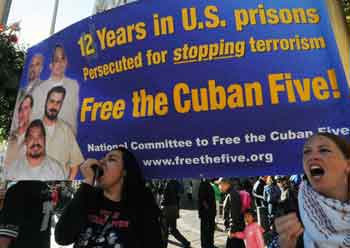
Free the Cuban 5 NOW!
| June 3, 2014 | 8:30 pm | Action, Cuban Five, International, National | Comments closed

A Call for action all over the world during the upcoming actions in Washington. We make a special appeal to friends of Cuba and the Five from around the world so that they can unite their voices from their countries to accompany the activities in Washington, with parallel actions from June 4 to 10 including sit-ins, demonstrations, pronouncements, art exhibits, a general twitazo, articles in the media, activation of social networks, etc.Free the Cuban 5

Comment on: “Krugman: How American Capitalism Fails—and Northern European ‘Socialism’ Succeeds—at Job Creation”
| May 28, 2014 | 9:16 pm | Action, Analysis, Economy, International, National | Comments closed

By Andre Brochu

Krugman is always good at peddling his snake oil.

There is no Scandinavian socialism and the universal welfare states in Sweden and
Denmark are at the morgue waiting for the coroners to go to work.
If you live in Scandinavia you can wonder about Krugman’s sources of data and analysis. There is more substance in good SciFi.

Any degree of Keynesianism to promote employment and public investment has
been reduced drastically since the Social Democrats joined the bourgeois parties
in promoting membership and integration in the EU. The false promise of a Social
EU has proven to be a lie before and after the last crisis. The EU is a neoliberal
project since its infancy with the Treaty of Rome. The so-called freedoms are for capital
and finance. Some people from the establishment have woken up. However, it is a little
late. Rightwing xenophobic populists have reaped a bumper crop of voters in the lastest EU
elections since their false but down to earth arguments and propaganda have
convinced many of the unemployed, frustrated and scared electorate. The Social Democrats
and the parliamentary left don’t address economically or ideologically the problems
of the unemployed, underemployed, and youth who face at best job insecurity and
an inability even when working to gain basic social benefits.

The late Peter Cohen wrote cogently on what was developing in Scandinavia
twenty years ago in an article in Monthly Review which is still relevant :
Sweden: The Model That Never Was by Peter Cohen
1994, July-August, Volume 46, Monthly Review
This article is essential to any analysis and debunking of Krugman’s mythology.

Before the referendum for Sweden’s EU membership in 1994 the CEO of Volvo Per
Gyllenhammar delineated the goal of the EEC/EU : long-term low wage increases,
reduced taxation, dismantling of the public sector and reduced welfare benefits.
The Swedish Rockefeller, Peter Wallenberg, said that an EEC/EU membership would result in the most dramatic changes in Sweden in the last hundred years. He drew the same conclusions as Gyllenhammar adding that public services would be privatized to a great degree. Today we have an underfinanced public sector with dire consequences for public health, employment, education, housing and infrastructure.

In conclusion there is at least a burgeoning protest movement against the EU-USA Free Trade Treaty (TTIP/TAFTA) throughout the EU. There should be Transatlantic cooperation on this
issue.

Krugman is part of the problem and not part of the solution. Let him sleep on like Rip Van
Winkle.

Krugman: How American Capitalism Fails—and Northern European ‘Socialism’ Succeeds—at Job Creation
| May 28, 2014 | 9:11 pm | Action, Analysis, Economy, National | Comments closed

http://www.alternet.org/economy/krugman-how-american-capitalism-fails-and-northern-european-socialism-succeeds-job-creation

AlterNet / By Janet Allon

And why that’s not a story the mainstream media likes to tell.

May 26, 2014 |

Paul Krugman wrote his column this morning in the New York Times from Europe, a place which—conservatives like Paul Ryan would like you to believe—demonstrates the complete failure of the welfare state. That’s because, as Krugman points out, “Our political discourse is dominated by reverse Robin-Hoodism — the belief that economic success depends on being nice to the rich, who won’t create jobs if they are heavily taxed, and nasty to ordinary workers, who won’t accept jobs unless they have no alternative.”

France, a country that the American media and conservatives particularly love to bash, is having particular success in employment rates. Krugman reports this “startling, little-known fact: French adults in their prime working years (25 to 54) are substantially more likely to have jobs than their U.S. counterparts.”

Hmmm. There’s a story you won’t hear told in the mainstream media.

He continues:

It wasn’t always that way. Back in the 1990s Europe really did have big problems with job creation; the phenomenon even received a catchy name, “Eurosclerosis.” And it seemed obvious what the problem was: Europe’s social safety net had, as Representative Paul Ryan likes to warn, become a “ hammock” that undermined initiative and encouraged dependency.

But then a funny thing happened: Europe started doing much better, while America started doing much worse. France’s prime-age employment rate overtook America’s early in the Bush administration; at this point the gap in employment rates is bigger than it was in the late 1990s, this time in France’s favor. Other European nations with big welfare states, like Sweden and the Netherlands, do even better.

What about young people? Doesn’t America, with all of its problems, still kick France’s ass when it comes to the employment rate of those younger than 25. Yes, Krugman concedes. Then he wonders if that is something we should be bragging about, since it is certainly due in part to the fact that French students receive a lot more financial aid for their education than American students do, so they are not immediately saddled with huge debt to work off, much less work their way through school.

“Is that a bad thing”” Krugman wonders.

Us too.

Also, the French take more vacations and retire earlier than we do.

How horrible! Who would want to live in a place like that.

But, getting back to Krugman’s main point: “On the core issue of providing jobs for people who really should be working, at this point old Europe is beating us hands down despite social benefits and regulations that, according to free-market ideologues, should be hugely job-destroying.”

In fact, he writes, our “cruel experiment” in depriving so-called lazy unemployed Americans of their long-term benefits so they will get off their asses and look for work has been an abject failure. Did people in terrible straits find jobs?

“No — not at all,” Krugman replies. “Somehow, it seems, the only thing we achieved by making the unemployed more desperate was deepening their desperation.”

Will people listen to the European example? Krugman is doubtful. He concludes:

I’m sure that many people will simply refuse to believe what I’m saying about European strengths. After all, ever since the euro crisis broke out there has been a relentless campaign by American conservatives (and quite a few Europeans too) to portray it as a story of collapsing welfare states, brought low by misguided concerns about social justice. And they keep saying that even though some of the strongest economies in Europe, like Germany, have welfare states whose generosity exceeds the wildest dreams of U.S. liberals.

The State Department’s Ukraine Fiasco
| May 26, 2014 | 6:28 pm | Action, Analysis, International, National | Comments closed

May 24, 2014

http://consortiumnews.com/2014/05/24/the-state-departments-ukraine-fiasco/

Exclusive: The State Department’s handling of the Ukraine crisis may go down as a textbook diplomatic fiasco, doing nothing to advance genuine U.S. interests while disrupting cooperation with Moscow and pushing Russia and China back together, reports Robert Parry.

By Robert Parry

American diplomacy, by definition, is supposed to advance the national interests of the United States, not contribute to international crises that undermine those interests. Yet, by that standard, the U.S. State Department and Secretary of State John Kerry have failed extraordinarily during the current Ukraine crisis.

Besides ripping Ukraine apart – and getting scores of Ukrainians killed – the U.S.-supported coup in February has injected more uncertainty into Europe’s economy by raising doubts about the continued supply of Russian natural gas. Such turbulence is the last thing that Europe’s fragile “recovery” needs as mass unemployment now propels the rise of right-wing parties and threatens the future of the European Union.

Any new business downturn in Europe also would inflict harm on the U.S. economy, which itself is still clawing its way out of a long recession and needs a healthy Europe as an important trading partner. But the crisis in Ukraine, spurred on by Assistant Secretary of State for European Affairs Victoria Nuland and other anti-Russian hardliners, is now complicating the U.S. recovery, too.

There’s also the problematic impact of pulling Ukraine out of Russia’s orbit and locking it into Europe’s: the scheme would shift the financial burden for Ukraine’s impoverished population of 45 million people onto Europe’s back, even as the EU is straining to meet the human needs of the jobless in Greece, Spain and other countries devastated by the Great Recession.

One of Ukraine’s principal exports to Europe has been low-wage Ukrainian workers, including participants in the criminal underworld, most notably prostitution. The willingness of Ukrainians to take the lowest-paying jobs across Europe has exacerbated the Continent’s unemployment situation and is sure to become an even bigger problem if a bankrupt Ukraine is more fully integrated into Europe.

Plus, the State Department’s endless stoking of tensions between President Barack Obama and Russian President Vladimir Putin has caused other complications for U.S. foreign policy, including what is emerging as a historic rapprochement between China and Russia, a coming together highlighted by the signing of a major new gas deal on Wednesday.

The $400 billion pact means that Putin, in effect, has countered U.S. efforts to use limited U.S./EU sanctions to isolate Russia by deftly playing the China card and aligning the two emerging countries as an economic and political counterforce to American dominance.

Though the natural gas deal has been in the works for months, the Ukraine crisis provided the urgency to get the agreement signed. The crisis also provided the impetus to solidify the closer geopolitical bonding between China, the world’s ascending economy, and Russia, its resource-rich neighbor.

The two longtime adversaries, who faced off as communist rivals during the Cold War, have joined together recently as a bloc on the United Nations Security Council to block Western initiatives on Syria, for instance. That means that instead of isolating Russia at the UN, the State Department’s hawkish approach to Ukraine has had the opposite effect. Russia now has a new and powerful ally.

The Ukraine crisis could inflict other collateral damage on President Obama’s initiatives toward resolving thorny disputes around Syria’s civil war and Iran’s nuclear program. In both areas, President Putin provided important assistance to President Obama in securing agreements: Syria to surrender its chemical weapons and Iran to accept constraints on its nuclear activity.

Though the Russians have not pulled out of those U.S. collaborations yet, the strains over Ukraine – if they are not eased – could undermine valuable cooperation toward reaching resolution of those two complicated and dangerous Mideast problems.

Pouring Fuel in the Fire

Yet, even as President Putin and other Russian leaders have tempered their rhetoric regarding Ukraine in recent weeks, the U.S. State Department continues to talk tough, bombarding Putin with both warnings and insults.

Typical were the comments in the lead story of the Washington Post on Saturday with writer Karen DeYoung quoting State Department and other U.S. officials berating Putin despite his conciliatory remarks about his willingness to work with the new Ukrainian government that will emerge from a disputed election on Sunday.

She wrote: “Western governments express deep uncertainty at what Russia will do, and it was symptomatic of their equally deep mistrust of Putin that few took him at his word [about working with the new government]. U.S. officials parsed his language as leaving a hole big enough to drive a brigade of Russian soldiers through.”

The Post quoted the harsh rhetoric emanating from State Department spokeswoman Marie Harf, who told the Russians: “Pull the rest of your troops back. … Put your money where your words are. Come on.”

DeYoung herself termed the Russian military deployment along Ukraine’s eastern border “threatening,” but didn’t mention the Russian rationale for the initial deployment, as an effort to deter the slaughter of ethnic Russians in eastern Ukraine who objected to the violent overthrow of their elected President Viktor Yanukovych. This context of what’s happening in eastern Ukraine is almost always missing.

Instead, the major U.S. news media, particularly the New York Times, has made great fun by mocking Putin as a liar for saying that, first, he had ordered Russian troops to pull back from the border, and then that he ordered some to return to their bases. The Times conflated these two different statements as one and then favorably quoted NATO Secretary General Anders Fogh Rasmussen as saying there was no evidence of a Russian pullback. Gotcha, another Putin lie!

Yet, while showing their trust in Rasmussen’s honesty and forthrightness, the Times and other mainstream outlets haven’t bothered to inform their readers that this was the same Anders Fogh Rasmussen who as Danish prime minister last decade was a staunch supporter of the Iraq War and a gullible believer in President George W. Bush’s claims about Iraq’s non-existent WMD.

For instance, Prime Minister Rasmussen declared, “Iraq has WMDs. It is not something we think, it is something we know. Iraq has itself admitted that it has had mustard gas, nerve gas, anthrax, but Saddam won’t disclose. He won’t tell us where and how these weapons have been destroyed. We know this from the UN inspectors, so there is no doubt in my mind.”

Pretty much everything in that statement was wrong — and Rasmussen appears to have been wrong, too, about Russia’s pullback of troops, which has now been confirmed, at least in part, by the Pentagon. But, for days, the Times let Rasmussen, in effect, call Putin a liar without any independent checking, just one more sign of the long pattern of U.S. media bias against Russia during the Ukraine crisis. [See Consortiumnews.com’s “Twisting Putin’s Words on Ukraine.”]

Blaming Russia

In line with that bias pervading the mainstream U.S. media for months, the Post’s DeYoung added her own inflammatory rhetoric, stating “if Russian-inspired violence breaks out, it could be the start of far more serious and widespread international upheaval.” All violence, it seems, must be “Russian-inspired.”

DeYoung is presumably referring to the resistance in eastern Ukraine against the imposition of the coup regime’s authority. The U.S. media has repeatedly treated these ethnic Russians in the east as Putin’s “minions,” being armed and directed by Russian special forces although no evidence has emerged to support that allegation.[See Consortiumnews.com’s “NYT Retracts Russian-Photo Scoop.”]

But DeYoung’s characterization of “Russian-inspired violence” fits with Official Washington’s “group think” that has treated the Ukraine crisis as instigated by Putin supposedly so he can begin reclaiming territory lost when the Soviet Union collapsed in 1991.

But the evidence clearly indicates that the uprising in Kiev was driven by a mix of popular dissatisfaction with Yanukovych, Western support and encouragement for the disorders, and violent neo-Nazi militias that despise the ethnic Russians in the east and spearheaded the Feb. 22 putsch that drove Yanukovych from office.

Still, the U.S. mainstream media has insisted on whitewashing the neo-Nazis brown shirts because their key involvement complicates the preferred American narrative of white-hat idealistic protesters taking on black-hat Yanukovych, backed by even blacker-hat Putin. Any reference to the well-documented role of neo-Nazis militias in the putsch is dismissed as “Russian propaganda” or the “Russian narrative.” [See Consortiumnews.com’s “Ukraine’s Inconvenient Neo-Nazis.”]

So, instead of a balanced account, the American people have been fed Official Washington’s “group think” of some master conspiracy engineered by Putin that requires your believing that Putin first orchestrated the EU’s reckless association offer to Ukraine last year, then got the International Monetary Fund to insist on draconian austerity measures which Yanukovych rejected, then arranged the angry demonstrations at the Maidan while also secretly training neo-Nazi militias in western Ukraine to provide the muscle to carry out the February putsch – all the while pretending that he was trying to save Yanukovych’s government and appearing to be distracted by the Winter Olympics in Sochi.

Of course, this grand conspiracy theory never made any sense and also lacked any evidence. What really happened was that neoconservatives in and around the State Department and Congress fed the flames of western Ukraine’s discontent against Yanukovych’s government that had been elected primarily with votes from the southern and eastern ethnic Russian sections.

The Neocon Role

There were, of course, legitimate complaints about Ukraine’s pervasive political corruption, which has been an endemic problem since the hasty privatization that followed the Soviet collapse in 1991 and turned Ukraine into a country dominated by a handful of extremely wealthy oligarchs.

But the evidence is clear that powerful neoconservatives in Washington, including some still ensconced at the State Department, helped organize U.S. support for the protests that led to Yanukovych’s ouster.

In late September, the neocons were furious over Putin helping Obama find a way out of an impending U.S. attack on Syria, an intervention that the neocons hoped might notch another “regime change” on their belts. So, their focus quickly turned to driving a wedge between the two leaders, with Ukraine becoming that wedge.

Carl Gershman, a leading neocon and longtime president of the U.S.-funded National Endowment for Democracy, took to the op-ed page of the neocon-flagship Washington Post to urge the U.S. government to push European “free trade” agreements on Ukraine and other former Soviet states and thus counter Moscow’s efforts to maintain close relations with those countries.

The ultimate goal, according to Gershman, was isolating and possibly toppling Putin in Russia with Ukraine the key piece on this global chessboard. “Ukraine is the biggest prize,” Gershman wrote. “Russians, too, face a choice, and Putin may find himself on the losing end not just in the near abroad but within Russia itself.”

In furtherance of these goals, NED funded scores of projects in Ukraine, training activists, financing “journalists” and organizing business groups, according to NED’s annual report.

After Yanukovych rejected the IMF’s terms for European association as too drastic – because they would hit the already hard-hit Ukrainian people even harder – his removal from power became the State Department’s goal, as Assistant of State Nuland urged on the demonstrators in the Maidan by passing out cookies and reminded Ukrainian business leaders that the United States had invested $5 billion in their “European aspirations.”

Sen. John McCain, a leading neocon hawk, also showed up in Kiev to rally the protesters, speaking next to a Svoboda party banner honoring World War II Nazi collaborator Stepan Bandera whose paramilitary force helped exterminate Jews and Poles. Bandera is a hero to the right-wing nationalists in western Ukraine though despised by the ethnic Russians in eastern Ukraine.

In an intercepted phone call, Nuland was caught telling U.S. Ambassador Geoffrey Pyatt that her preference to replace Yanukovych was Arseniy Yatsenyuk, whom she called “Yats.” After the Feb. 22 coup, Yatsenyuk emerged as the new prime minister with the neo-Nazis gaining control of four ministries, including the office of national security headed by neo-Nazi Andriy Parubiy. [See Consortiumnews.com’s “Ukraine, Through the US ‘Looking Glass’.”]

One of Yatsenyuk’s first moves was to approve the IMF austerity plan, while Parubiy incorporated some of the neo-Nazi militias into the National Guard and dispatched them as storm troopers to confront the resistance to the coup regime in the east.

Amid all the political chaos and violations of the Ukrainian constitution (which was ignored in the abrupt impeachment of Yanukovych), Crimea arranged a hasty referendum which showed some 96 percent support for seceding from Ukraine and rejoining Russia, a request that Putin and the Russian government accepted.

Typically, the New York Times and other major outlets summarize the Crimean switch as a Russian “invasion” with Putin supposedly dispatching troops to seize control of the peninsula with the help of a “sham” referendum.

Almost never does the U.S. press note that the Russian troops were already in Crimea under an arrangement with Ukraine allowing Russians to maintain their historic naval base at Sevastapol. The vote also clearly reflected the popular will of the Crimean people given their historic ties to Russia and the chaos in Ukraine.

Medvedev’s Comments

“We did not annex any part of Ukraine,” Russian Prime Minister Dmitry Medvedev told Bloomberg News this past week, “The population of the Autonomous Republic of Crimea held a referendum and voted for self-determination and for joining Russia in accordance with the existing procedure. And that’s what they did.

“They started by proclaiming independence and after that, they asked to join Russia. We satisfied their request. The Russian Constitution was amended so that Crimea could join Russia as the result of a popular vote. Crimea is a special and unique story.” That was a reference to Crimea being a longtime part of Russia.

Regarding any other parts of Ukraine, Medvedev added, “Any conjectures about Russia wanting to annex some territories are mere propaganda. … It is essential to calm tensions in Ukraine. We all see what’s happening there: the situation is nothing short of a civil war, as a matter of fact. This is what we should all be thinking about.”

Pressed by Bloomberg’s Ryan Chilcote on guaranteeing that Russia would not accede to requests from Ukrainian separatists in eastern Ukraine, Medvedev responded, “we (I’m referring to all those who sympathize with Ukraine – European countries and as far as I understand, the United States and, of course, Russia, which is the closest to Ukraine) should do all we can to de-escalate tensions – a measure that everyone is talking about now.

“In other words, we should do everything to stop the spread of civil war on Ukrainian territory. As for the positions of people in Lugansk, Donetsk and other [eastern] parts of Ukraine, our stance is simple – their positions deserve respect. If they hold some referendums, we should understand what they want and why they express such views.

“So in the future, the main point is to make sure that Ukraine’s central, de facto authorities and those who live in these parts of Ukraine establish a fully-fledged dialogue based on mutual respect and understanding, a dialogue that takes into account the position of eastern Ukraine. This would ease tensions; otherwise the conflict will continue, and we will most likely hear the same appeals [for secession] that were discussed at the referendums.”

Medvedev added: “Let our partners in the dialogue, namely the EU and the United States, guarantee us something, for example, that they won’t interfere in Ukraine’s internal affairs. Let our Western partners guarantee us that they won’t lure Ukraine into NATO, that the Russian language won’t be prohibited in eastern Ukraine, and that some senseless movement such as the Right Sector won’t start killing people there. Let our partners guarantee this.”

The key Ukraine question now is: Can Putin and Obama overcome Official Washington’s chest-thumping hysteria and deescalate the violence — along with the rhetoric — for the good of all rational parties in the dispute?

I’m told that Putin, though stung by Obama initially joining the anti-Russian stampede, has begun working again with Obama with the goal of a possible summit meeting in Normandy on June 6 during the ceremonies honoring the 70th anniversary of D-Day.

Yet, even if the pieces of a shattered Ukraine can be glued back together, one still has to wonder why the U.S. State Department and other parts of Official Washington undertook this provocative project in the first place: contributing to the overthrow of Ukraine’s elected government, violently destabilizing the country, heightening tensions with Russia, stirring up new threats to the EU and U.S. economies, and pushing Russia and China back together.

It may be understandable at some level that the still-powerful neocons saw the Ukraine wedge as a useful tool in splintering the Putin-Obama cooperation that had eased tensions over Syria and Iran – two of the neocons’ top targets for “regime change” – but it remains a mystery how anyone could think that the Ukraine adventure has served U.S. national interests.

Investigative reporter Robert Parry broke many of the Iran-Contra stories for The Associated Press and Newsweek in the 1980s. You can buy his new book, America’s Stolen Narrative, either in print here or as an e-book (from Amazon and barnesandnoble.com).

Cuban Five: A Prisoner Exchange that Could Improve Relations Between Cuba and the United States
| May 18, 2014 | 8:19 pm | Action, Analysis, Cuban Five, International, National | Comments closed

www.thecuban5.orgzzz-cuban5

May 15, 2014

By Salim Lamrani

Since 2009, U. S. agent Alan Gross has been serving a fifteen year prison sentence in Cuba for providing material support to the Cuban opposition. In the meanwhile, three Cuban agents have been incarcerated in the United States since 1998. The possibility of an exchange of prisoners exists. The case of Gerardo Hernández, one of the three Cubans sentenced to two terms of life imprisonment, lends itself particularly well to such a humanitarian agreement. Here, in 25 points, are the reasons why.

1. Following the collapse of the Soviet Union in the 1990s, the radical sector of the Florida-based Cuban exile community increased its terrorist attacks against Cuba. The tourism industry – a vital sector of the fragile Cuban economy – was a particular target. Bomb attacks resulted in dozens of casualties. Faced with the immunity these violent fringe groups were receiving from U.S. authorities, the Havana government decided to send several agents to the United States to infiltrate these criminal organizations and prevent the realization of further potentially lethal acts.

2. In June 1998, after gathering evidence about the terrorist activities of 64 exiles living in Florida, the Cuban government invited two FBI officers to Havana in order to present them with the evidence that it had accumulated. But, rather than arresting those responsible for these crimes, the FBI arrested the five Cuban intelligence services agents who had infiltrated the criminal organizations: René González Sehweret, Ramón Labañino Salazar, Fernando González Llort, Antonio Guerrero Rodriguez and Gerardo Hernández Nordelo.

3. Following a trial that has been denounced by many legal institutions for its numerous irregularities, the five Cubans nonetheless won their case on appeal from a three-judge panel of the Atlanta Court of Appeals. The tribunal found that they had not received a fair trial. The U.S. government, however, lodged an appeal and the Five eventually received a total of four sentences of life imprisonment, and an additional sentence of 77 years. On October 13, 2009, the Atlanta Court of Appeals instructed the Florida court to modify the prison sentences for three of the five defendants. The review that was conducted resulted in Antonio Guerrero’s penalty of life imprisonment plus 10 years being changed to 21 years plus 10 months, plus an additional penalty of five years of supervised release. On December 8, 2009, Fernando González’ sentence of 19 years was reduced to 17 years plus nine months. In the case of Ramón Labañino, his sentence of imprisonment for life plus 18 years was reduced to 30 years in prison. Rene González and Fernando González were freed after serving their entire sentences.

4. Gerardo Hernández was sentenced to two terms of life imprisonment plus 15 years in prison for conspiracy to commit a quadruple murder. He is accused of being directly involved in an incident that occurred on February 24, 1996. That day two planes, manned by four pilots from the Florida-based organization Brothers to the Rescue (BTTR), were shot down by Cuban armed forces after having violated Cuban airspace 25 times in 20 months.

5. José Basulto, president of BTTR, a former CIA officer who had participated in the Bay of Pigs invasion, is heavily implicated in terrorist acts against Cuba. In a Miami television interview Basulto publicly admitted to having participated in several strikes against Cuba, including a bazooka attack on a hotel in August of 1962.

6. BTTR was founded in 1991 to assist the Cubans trying to reach Florida by sea. In 1994, Washington and Havana signed immigration agreements that authorized the granting of 20,000 visas per year to Cubans wishing to emigrate. These agreements also provide that any person attempting to reach the United States by sea would be returned to Cuba. With this agreement, BTTR lost its reason for being and has since begun organizing raids inside Cuban airspace.

7. A chronology of events permits us to capture the key elements of this story. During the months preceding the serious incident of February 24, 1996, Cuban authorities warned the United States frequently, both through diplomatic notes and unofficial channels, that repeated violations of its airspace constituted a threat to Cuban national security and that the planes involved were running the risk of being shot down. Washington chose to ignore these warnings.

8. Ignoring the risk of being shot down, BTTR aircraft on several occasions provoked the Cuban armed forces by entering Cuban national airspace. In addition to its forays over the capital, BTTR planes created interference between the Havana control tower and aircraft landing at José Martí International Airport, thereby endangering the lives of thousands of Cuban passengers and foreign tourists.

9. On July 13, 1995, BTTR planes flew over the city of Havana and dropped 20,000 leaflets, inciting the population to rise up against the government.

10. On the same day, Cuban authorities sent a letter emphasizing the possibility of a military response to the Federal Aviation Administration. The letter underscored the illegal incursions into Cuban national airspace and the “serious consequences” that such acts could entail if they were to continue .

11. The Government of the United States, instead of taking the necessary measures to prevent such violations of international law, allowed BTTR the latitude necessary to pursue their incursions, despite the fact that the organization, since 1994, had repeatedly filled false flight plans with the Federal Aviation Administration.

12. At no time had Gerardo Hernández participated in the Cuban airspace violations, nor had he incited BTTR members to commit these illegal and dangerous acts. Moreover, Hernandez had never participated at the necessary hierarchical level within BTTR to prevent these flights. Everything was under the control of José Basulto.

13. The State Department issued several statements warning BTTR that its planes ran the risk of being shot down if they continued to violate Cuban airspace.

14. In January 1996, BTTR dropped 500,000 leaflets over Havana inciting the population to overthrow the government. On January 15, 1996, Cuba once again demanded that the U.S. put an end to the repeated violations of its airspace.

15. After new breaches of their national airspace in January 1996, Cuba warned Washington that if these overflights continued, the aircraft would be shot down. Havana reiterated these warnings to all U.S. public figures who visited the island between January 15 and February 23, 1996.

16. On January 22, 1996, the State Department sent an alert to the Federal Aviation Administration: “One of these days, the Cubans are going to shoot down one of those planes .” José Basulto had repeatedly stated in the media that he was aware of the danger.

17. In February 1996, Cuban authorities sent a message to their agents in Miami indicating that in no case should they participate in BTTR flights.

18. On February 23, 1996, the Federal Aviation Agency sent an “Alert Cuba” message to several agencies indicating that BTTR planned a new foray into Cuban airspace the following day. “The State Department said it would be unlikely that the Cuban government would exercise restraint this time .”

19. On 24 February 1996, the government of the United States warned the Cuban authorities that three BTTR planes had taken off from Miami and were able to penetrate Cuban airspace.

20. After several warnings, two of the three planes were shot down by Cuban forces in Cuban airspace, an action that constitutes an act of self-defence under international law. No country in the world – certainly not the United States – would have waited until the 26th violation of its airspace by an organization, after having made numerous appeals for help, to take such a measure.

21. However, the United States asserts that, according to its satellite data, the two planes were shot down in the international zone, which would constitute the crime for which Gerardo Hernández is accused. Of course, publication of satellite data would remove any ambiguity about the matter. However, since 1996, the United States has refused, for reasons of “national security,” to make this information public despite repeated requests from Gerardo Hernández’ lawyers.

22. In any case, Hernández has not been implicated in the decision to shoot down the planes, a decision that was taken by the Cuban authorities at the highest level.

23. In order to convict Gerardo Hernández, the prosecution needed to prove that there had been an illegal scheme afoot to shoot down BTTR aircraft in international airspace and that Hernández had precise knowledge of this scheme and in fact had supported such an action. The prosecution was unable to provide any evidence demonstrating the involvement of Gerardo Hernández in this drama. Better yet, the prosecutor acknowledged that “the evidence presented at trial that attempts [to prove the involvement of Gerardo Hernández] represents an insurmountable obstacle for the United States .”

24. Judge Phyllis A. Kravitch of the Atlanta Court of Appeals has spoken about the case of Gerardo Hernández: “A shoot down in Cuban airspace would not have been unlawful […]. It is not enough for the Government to show that a shoot down merely occurred in international airspace: the Government must prove beyond a reasonable doubt that Hernández agreed to a shoot down in international airspace. Although such an agreement may be proven by circumstantial evidence, here, the Government failed to provide either direct or circumstantial evidence that Hernández agreed to a shoot down in international airspace. Instead, the evidence points out toward a confrontation in Cuban airspace, thus negating the requirement that he agreed to commit an unlawful act.”

25. For all of these reasons, Barack Obama should use his powers as President of the United States and pardon the three Cubans that are still imprisoned. This will have the immediate effect of freeing Alan Gross and improving relations between Washington and Havana.

Translated from the French by Larry R. Oberg

Docteur ès Etudes Ibériques et Latino-américaines at the University of Paris Sorbonne-Paris IV, Salim Lamrani is a Lecturer the University of La Réunion, and a journalist who specializes in relations between Cuba and the United States.

The author’s latest book is The Economic War against Cuba. A Historical and Legal Perspective on the U.S. Blockade, New York, Monthly Review Press, 2013. http://monthlyreview.org/press/books/pb3409/  (prologue by Wayne S. Smith and preface by Paul Estrade).

http://www.globalresearch.ca/cuban-five-a-prisoner-exchange-that-could-improve-relations-between-cuba-and-the-united-states/5382416

Contact : lamranisalim@yahoo.fr  ; Salim.Lamrani@univ-reunion.fr

Facebook : https://www.facebook.com/SalimLamraniOfficiel