Category: Analysis
The struggle of the working class against fascism
| May 12, 2014 | 7:48 am | Action, Analysis, International | Comments closed

http://www.marxists.org/reference/archive/dimitrov/works/1935/08_02.htm#s8

part of

Georgi Dimitrov

The Fascist Offensive and the Tasks of the Communist International in the Struggle of the Working Class against Fascism

III. CONSOLIDATION OF THE COMMUNIST PARTIES AND THE STRUGGLE FOR POLITICAL UNITY OF THE PROLETARIAT

Comrades, in the struggle to establish a united front the importance of the leading role of the Communist Party increases extraordinarily. Only the Communist Party is at bottom the initiator, the organizer and the driving force of the united front of the working class.

The Communist Parties can ensure the mobilization of the broadest masses of working people for a united struggle against fascism and the offensive of capital only if they strengthen their own ranks in every respect, if they develop their initiative, pursue a Marxist-Leninist policy and apply correct, flexible tactics which take into account the actual situation and alignment of class forces.

III. CONSOLIDATION OF THE COMMUNIST PARTIES

In the period between the Sixth and Seventh Congress, our Parties in the capitalist countries have undoubtedly grown in stature and have been considerably steeled. But it would be a most dangerous mistake to rest content with this achievement. The more the united front of the working class extends, the more will new, complex problems arise before us and the more will it be necessary for us to work on the political and organizational consolidation of our Parties. The united front of the proletariat brings to the fore an army of workers who will be able to carry out their mission if this army is headed by a leading force that will point out its aims and paths. This leading force can only be a strong proletarian, revolutionary party.

If we Communists exert every effort to establish a united front, we do this not for the narrow purpose of recruiting new members for the Communist Parties. But we must strengthen the Communist Parties in every way and increase their membership for the very reason that we seriously want to strengthen the united front. The strengthening of the Communist Parties is not a narrow Party concern but the concern of the entire working class.

The unity, revolutionary solidarity and fighting preparedness of the Communist Parties constitute a most valuable capital which belongs not only to us but to the whole working class. We have combined and shall continue to combine our readiness to march jointly with the Social-Democratic Parties and organizations to the struggle against fascism with an irreconcilable struggle against Social-Democracy as the ideology and practice of compromise with the bourgeoisie, and consequently also against any penetration of this ideology into our own ranks.

In boldly and resolutely carrying out the policy of the united front, we meet in our own ranks with obstacles which we must remove at all costs in the shortest possible time.

After the Sixth Congress of the Communist International, a successful struggle was waged in all Communist Parties of the capitalist countries against any tendency towards an opportunist adaptation to the conditions of capitalist stabilization and against any infection with reformist and legalist illusions. Our Parties purged their ranks of various kinds of Right opportunists, thus strengthening their Bolshevik unity and fighting capacity. Less successful, and frequently entirely lacking, was the fight against sectarianism. Sectarianism no longer manifested itself in primitive, open forms, as in the first years of the existence of the Communist International, but, under cover of a formal recognition of the Bolshevik theses, hindered the development of a Bolshevik mass policy. In our day this is often no longer an “infantile disorder,” as Lenin wrote, but a deeply rooted vice, which must be shaken off or it will be impossible to solve the problem of establishing the united front of the proletariat and of leading the masses from the positions of reformism to the side of revolution.

In the present situation sectarianism, self-satisfied sectarianism, as we designate it in the draft resolution, more than anything else impedes our struggle for the realization of the united front: sectarianism, satisfied with its doctrinaire narrowness, its divorce from the real life of the masses, satisfied with its simplified methods of solving the most complex problems of the working class movement on the basis of stereotyped schemes; sectarianism which professes to know all and considers it superfluous to learn from the masses, from the lessons of the labor movement; in short, sectarianism, to which as they say, mountains are mere stepping-stones.

Self-satisfied sectarianism will not and cannot understand that the leadership of the working class by the Communist Party does not come of itself. The leading role of the Communist Party in the struggles of the working class must be won. For this purpose it is necessary, not to rant about the leading role of the Communists, but to earn and win the confidence of the working masses by everyday mass work and a correct policy. This will be possible only if in our political work we Communists seriously take into account the actual level of the class consciousness of the masses, the degree to which they have become revolutionized, if we soberly appraise the actual situation, not on the basis of our wishes but on the basis of the actual state of affairs. Patiently, step by step, we must make it easier for the broad masses to come over to the Communist position. We ought never to forget the words of Lenin, who warns us as strongly as possible:

… This is the whole point — we must not regard that which is obsolete for us, as obsolete for the class, as obsolete for the masses.
[V. I. Lenin, “Left-Wing” Communism, an Infantile Disorder, New York (1940), pp. 42; Collected Works 31:58]

Is it not a fact, comrades, that in our ranks there are still quite a few such doctrinaire elements, who at all times and places sense nothing but danger in the policy of the united front? For such comrades the whole united front is one unrelieved peril. But this sectarian “sticking to principle” is nothing but political helplessness in face of the difficulties of directly leading the struggle of the masses.

Sectarianism finds expression particularly in overestimating the revolutionization of the masses, in overestimating the speed at which they are abandoning the positions of reformism, and in attempting to leap over difficult stages and the complicated tasks of the movement. In practice, methods of leading the masses have frequently been replaced by the methods of leading a narrow party group. The strength of the traditional tie-up between the masses and their organizations and leaders was underestimated, and when the masses did not break off these connections, immediately the attitude taken toward them was just as harsh as that adopted toward their reactionary leaders. Tactics and slogans have tended to become stereotyped for all countries, the special features of the actual situation in each individual country being left out of account. The necessity of stubborn struggle in the very midst of the masses themselves to win their confidence has been ignored, the struggle for the partial demands of the workers and work in the reformist trade unions and fascist mass organizations have been neglected. The policy of the united front has frequently been replaced by bare appeals and abstract propaganda.

In no less a degree have sectarian views hindered the correct selection of people, the training and developing of cadres connected with the masses, enjoying the confidence of the masses, cadres whose revolutionary mettle has been tried and tested in class battles, cadres capable of combining the practical experience of mass work with a Bolshevik staunchness of principle.

Thus sectarianism has to a considerable extent retarded the growth of the Communist Parties, made it difficult to carry out a real mass policy, prevented our taking advantage of the difficulties of the class enemy to strengthen the positions of the revolutionary movement, and hindered the winning over of the broad masses of the proletariat to the side of the Communist Parties.

While fighting most resolutely to overcome and exterminate the last remnants of self-satisfied sectarianism, we must increase in every way our vigilance toward Right opportunism and the struggle against it and against every one of its concrete manifestations, bearing in mind that the danger of Right opportunism will increase in proportion as the broad united front develops. Already there are tendencies to reduce the role of the Communist Party in the ranks of the united front and to effect a reconciliation with Social-Democratic ideology. Nor must we lose sight of the fact that the tactics of the united front are a method of clearly convincing the Social-Democratic workers of the correctness of the Communist policy and the incorrectness of the reformist policy, and that they are not a reconciliation with Social-Democratic ideology and practice. A successful struggle to establish the united front imperatively demands constant struggle in our ranks against tendencies to depreciate the role of the Party, against legalist illusions, against reliance on spontaneity and automatism, both in liquidating fascism and in implementing the united front against the slightest vacillation at the moment of decisive action.

POLITICAL UNITY OF THE WORKING CLASS

Comrades, the development of the united front of joint struggle of the Communist and Social-Democratic workers against fascism and the offensive of capital also brings to the fore the question of political unity, of a single political mass party of the working class. The Social Democratic workers are becoming more and more convinced by experience that the struggle against the class enemy demands unity of political leadership, inasmuch as duality in leadership impedes the further development and reinforcement of the joint struggle of the working class.

The interests of the class struggle of the proletariat and the success of the proletarian revolution make it imperative that there be a single party of the proletariatin each country. Of course, it is not so easy or simple to achieve this. It requires stubborn work and struggle and is bound to be a more or less lengthy process. The Communist Parties, basing themselves on the growing urge of the workers for a unification of the Social-Democratic Parties or of individual organizations with the Communist Parties, must firmly and confidently take the initiative in this unification. The cause of amalgamating the forces of the working class in a single revolutionary proletarian party at the time when the international labor movement is entering the period of closing the split in its ranks, is our cause.

But while it is sufficient for the establishment of the united front of the Communist and Social-Democratic Parties to have an agreement to fight against fascism, the offensive of capital and war, the achievement of political unity is possible only on the basis of a number of certain conditions involving principles.

This unification is possible only on the following conditions:

First, complete independence from the bourgeoisie and dissolution of the bloc of Social-Democracy with the bourgeoisie;
Second, preliminary unity of action;
Third, recognition of the revolutionary overthrow of the rule of the bourgeoisie and the establishment of the dictatorship of the proletariat in the form of soviets a sine qua non;
Fourth, refusal to support one’s own bourgeoisie in an imperialist war;
Fifth, building up the Party on the basis of democratic centralism, which ensures unity of purpose and action, and which has been tested by the experience of the Russian Bolsheviks.
We must explain to the Social-Democratic workers, patiently and in comradely fashion, why political unity of the working class is impossible without these conditions. We must discuss together with them the sense and significance of these conditions.

Why is it necessary for the realization of the political unity of the proletariat that there be complete independence from the bourgeoisie and a rupture of the bloc of Social-Democrats with the bourgeoisie?

Because the whole experience of the labor movement, particularly the experience of the fifteen years of coalition policy in Germany, has shown that the policy of class collaboration, the policy of dependence on the bourgeoisie, leads to the defeat of the working class and to the victory of fascism. And the only true road to victory is the road of irreconcilable class struggle against the bourgeoisie, the road of the Bolsheviks.

Why must unity of action be first established as a preliminary condition of political unity?

Because unity of action to repel the offensive of capital and of fascism is possible and necessary even before the majority of the workers are united on a common political platform for the overthrow of capitalism, while the working out of unity of views on the main lines and aims of the struggle of the proletariat, without which a unification of the parties is impossible, requires a more or less extended period of time. And unity of views is worked out best of all in joint struggle against the class enemy already today. To propose to unite at once instead of forming a united front means to place the cart before the horse and to imagine that the cart will then move ahead. Precisely for the reason that for us the question of political unity is not a maneuver, as it is for many Social-Democratic leaders, we insist on the realization of unity of action as one of the most important stages in the struggle for political unity.

Why is it necessary to recognize the necessity of the revolutionary overthrow of the bourgeoisie and the setting up of the dictatorship of the proletariat in the form of soviet power?

Because the experience of the victory of the great October Revolution, on the one hand and, on the other, the bitter lessons learned in Germany, Austria and Spain during the entire postwar period have confirmed once more that the victory of the proletariat is possible only by means of the revolutionary overthrow of the bourgeoisie, and that the bourgeoisie would rather drown the labor movement in a sea of blood than allow the proletariat to establish socialism by peaceful means. The experience of the October Revolution has demonstrated patently that the basic content of the proletarian revolution is the question of the proletarian dictatorship, which is called upon to crush the resistance of the overthrown exploiters, to arm the revolution for the struggle against imperialism and to lead the revolution to the complete victory of socialism. To achieve the dictatorship of the proletariat as the dictatorship of the vast majority over an insignificant minority, over the exploiters — and only as such can it be brought about — for this soviets are needed embracing all sections of the working class, the basic masses of the peasantry and the rest of the working people, without whose awakening, without whose inclusion in the front of the revolutionary struggle, the victory of the proletariat cannot be consolidated.

Why is the refusal of support to the bourgeoisie in an imperialist war a condition of political unity?

Because the bourgeoisie wages imperialist wars for its predatory purposes, against the interests of the vast majority of the peoples, under whatever guise this war may be waged. Because all imperialists combine their feverish preparations for war with extremely intensified exploitation and oppression of the working people in their own country. Support of the bourgeoisie in such a war means treason to the country and the international working class.

Why, finally, is the building of the Party on the basis of democratic centralism a condition of unity?

Because only a party built on the basis of democratic centralism can ensure unity of purpose and action, can lead the proletariat to victory over the bourgeoisie, which has at its disposal so powerful a weapon as the centralized state apparatus. The application of the principle of democratic centralism has stood the splendid historical test of the experience of the Russian Bolshevik Party, the Party of Lenin.

This explains why it is necessary to strive for political unity on the basis of the conditions indicated.

We are for the political unity of the working class. Therefore, we are ready to collaborate most closely with all Social-Democrats who are for the united front and sincerely support unity on the above-mentioned principles.

But precisely because we are for unity, we shall struggle resolutely against all “Left” demagogues who try to make use of the disillusionment of the Social Democratic workers to create new Socialist Parties or Internationals directed against the Communist movement, and thus keep deepening the split in the working class.

We welcome the growing efforts among Social-Democratic workers for a united front with the Communists. In this fact we see a growth of their revolutionary consciousness and a beginning of the healing of the split in the working class. Being of the opinion that unity of action is a pressing necessity and the truest road to the establishment of the political unity of the proletariat as well, we declare that the Communist International and its sections are ready to enter into negotiations with the Second International and its sections for the establishment of the unity of the working class in the struggle against the offensive of capital, against fascism and the menace of an imperialist war.

CONCLUSION

Comrades, I am concluding my report. As you see, taking into account the change in the situation since the Sixth Congress and the lessons of our struggle, and relying on the degree of consolidation already achieved, we are raising a number of questions today in a new way, primarily the question of the united front and of the approach to Social-Democracy, the reformist trade unions and other mass organizations.

There are wiseacres who will sense in all this a digression from our basic positions, some sort of turn to the Right from the straight line of Bolshevism. Well, in my country, Bulgaria, they say that a hungry hen always dreams of millet. Let those political chickens think so.

This interests us little. For it is important that our own Parties and the broad masses throughout the world should correctly understand what we are striving for.

We would not be revolutionary Marxists, Leninists, worthy pupils of Marx, Engels, and Lenin, if we did not suitably reconstruct our policies and tactics in accordance with the changing situation and the changes occurring in the world labor movement.

We would not be real revolutionaries if we did not learn from our own experience and the experience of the masses.

We want our Parties in the capitalist countries to come out and act as real political parties of the working class, to become in actual fact a political factor in the life of their countries, to pursue at all times an active Bolshevik mass policy and not confine themselves to propaganda and criticism, and bare appeals to struggle for a proletarian dictatorship.

We are enemies of all cut-and-dried schemes. We want to take into account the concrete situation at each moment, in each place, and not act according to a fixed, stereotyped form anywhere and everywhere, not to forget that in varying circumstances the position of the Communists cannot be identical.

We want soberly to take into account all stages in the development of the class struggle and in the growth of the class consciousness of the masses themselves, to be able to locate and solve at each stage the concrete problems of the revolutionary movement corresponding to this stage.

We want to find a common language with the broadest masses for the purpose of struggling against the class enemy, to find ways of finally overcoming the isolation of the revolutionary vanguard from the masses of the proletariat and all other working people, as well as of overcoming the fatal isolation of the working class itself from its natural allies in the struggle against the bourgeoisie, against fascism.

We want to draw increasingly wide masses into the revolutionary class struggle and lead them to the proletarian revolution proceeding from their vital interests and needs as the starting point, and their own experience as the basis.

Following the example of our glorious Russian Bolsheviks, the example of the leading party of the Communist International, the Communist Party of the Soviet Union, we want to combine the revolutionary heroism of the German, the Spanish, the Austrian and other Communists with genuine revolutionary realism, and put an end to the last remnants of scholastic tinkering with serious political questions.

We want to equip our Parties from every angle for the solution of the highly complex political problems confronting them. For this purpose we want to raise ever higher their theoretical level, to train them in the spirit of living Marxism-Leninism and not fossilized doctrinairism.

We want to eradicate from our ranks all self-satisfied sectarianism, which above all blocks our road to the masses and impedes the carrying out of a truly Bolshevik mass policy.

We want to intensify in every way the struggle against concrete manifestations of Right opportunism, bearing in mind that the danger from this side will arise precisely in the course of carrying out our mass policy and struggle.

We want the Communists of every country promptly to draw and apply all the lessons that can be drawn from their own experience as the revolutionary vanguard of the proletariat. We want them as quickly as possible to learn how to sail on the turbulent waters of the class struggle, and not to remain on the shore as observers and registrars of the surging waves in the expectation of fine weather.

This is what we want.

And we want all this because only in this way will the working class at the head of all the working people, welded into a million-strong revolutionary army, led by the Communist International, be able to fulfil its historical mission with certainty — to sweep fascism off the face of the earth and, together with it, capitalism!

(At the close of the report all delegates joined in a lengthy ovation, cheering enthusiastically and singing the revolutionary songs of their countries.)

Regrets, I’ve Had a Few, but Then Again,…
| May 10, 2014 | 7:34 pm | About the CPUSA, Action, Analysis | Comments closed

http://mltoday.com/regrets-i-ve-had-a-few-but-then-again?utm

May 1, 2014

By the Austin Hogan Transit Club, NYC

“My Way”
And now, the end is here
And so I face the final curtain
My friend, I’ll say it clear
I’ll state my case, of which I’m certain
I’ve lived a life that’s full
I traveled each and ev’ry highway
And more, much more than this, I did it my way…
Regrets, I’ve had a few
But then again, too few to mention…

Frank Sinatra’s lyrics, above, came to mind when the national chair of the CPUSA recently wrote, “Whatever mistakes – and mistakes are inevitable – we have made, we haven’t made big mistakes, that is, mistakes of a strategic nature, like some others on the left have and a few in our party have advocated…”

Let’s start with a dose of reality and a pinch of common sense:

It’s probable that, no matter what we say or write in this Pre-Convention Discussion period, the clique now in charge will do as it damn well pleases. The upcoming convention will merely go through the motions of debate. Like a wrestling match, the phoniest of spectacles, the outcome is pre-determined.

Nevertheless we can still honor the memory of the heroes and heroines who built this once-important Party by fighting to the last bullet, as it were.

What questions should real Communists ask, as the 30th Convention nears? Not the pre-fabricated questions in “Guidelines for Pre-Convention Discussion.” They are unacceptable. They are meant to steer discussion into safe channels that do not challenge the basic misdirection of the party since 2000.

Instead, ask these questions:

· No big mistakes? Few in the world Communist movement accept the national chairman’s big idea, “A Party of Socialism for the 21st Century.“ It is obviously a social democratic political vision. It has been openly rejected by major voices in the international Communist movement, and privately rejected by dozens of other parties, who choose to be tactfully silent. It is no accident the NB is organizing internal discussions of social democracy, merger talks with CCDS and other social democratic groups, and planning a big presence at the social democratic Left Forum, not to mention, at the convention dropping Marxism-Leninism, the term, the substance, or both.
· Have we grown stronger or weaker? Weaker.
· Are we bigger or smaller? Smaller. Even the national chair of the Party admitted not long ago the Party is “dangerously small.” How can this be reconciled with the upbeat reports from top leaders that the Internet recruiting is bringing in many new people? Answer: It can’t be reconciled. Internet recruiting is a revolving door.
· Are we older or younger? Older
· Are our Party grassroots – the clubs — getting stronger? No, they are shriveling up. As well, club expulsions are taking place, but only clubs that question the line.
· Are our roots in the working class, the nationally oppressed and other specially oppressed groups getting stronger? No. We don’t give a lead on the struggles against racism. Instead, we cozy up to Obama, exaggerating his (rare) positive steps and ignoring most of his dreadful policies, which are countless.
· Is our trade union work better organized? No. The Labor Commission of the Party seems to be reduced to a cheerleader for the AFL-CIO.
· Are these negative trends caused by external factors? No. There is no anti-Communist persecution. The damage is self-inflicted
· Are we leading any movements? No. We’re not even trying. “Followership” is now the supreme principle, it seems.
· Have the estimates of the party leadership proved correct? Not long ago, the national chairman was predicting under the present Administration we would see “an era of democratic reform.”
· Is Party growth impossible? No. Objective conditions for party growth are excellent. If masses of people are suffering and want to discuss “socialism” — however understood by un-informed people — why is the Party vanishing?
· Is our anti-war work stronger and more effective? Hardly. A few comrades carry on valiantly against Obama’s warlike policies. There has been no sizable anti-war demonstration in Washington DC in ages.

Who, or What, is to Blame?

The problem facing the CPUSA, what little remains of it, is its fundamental political direction. The line is wrong. Four more years of this direction will surely kill the Party off.

The leaders who pushed for and presided over this debacle should not just retire; they should do penance and make restitution. They should be down on their knees, begging us for forgiveness. In a just world, they would be held accountable. But, alas, the world is not just. Instead, we see them maneuvering to ensure that successors are chosen who will continue to carry out the disastrous policies. Some call that “Taking Care of the Future.”

“Party of 21st Century Browderism.” The miscalculating Browder liquidated the Party abruptly. He soon faced a revolt. More cunning than Browder, the present leadership, arriving in 2000, has injected the opportunist poison into the arteries of the organization, in small doses. The sickening and enfeeblement of the Party over 14 years have rendered it moribund. Now death is at hand.

It is hard to hold out much hope for this 30th — and perhaps last — CPUSA Convention. One hears reports that certain districts are being assigned ridiculously inflated voting weights that in no way reflect the shrunken and demoralized membership.

Our Wish List

Should leaders be held accountable for outcomes of their policies? Well, they are in every other sphere of democratic life. Why not in the CPUSA?
Here’s our wish list for this convention:

1. The whole NB should be removed. If there are any “good” people on the NB, they kept their mouth shut for years. Therefore, they’re not good revolutionary material. From among what is left of healthy forces on the NC, an opposition slate should be formed, composed of real Communists.
2. The first priority of a new leadership should be to change the Party line from this absurd ”unity against the ultra right“ (which means, in practice, work for the Democrats) to our classic position, the anti-monopoly strategy.
3. It will probably take an emergency 31st CPUSA convention to undo the top-to-bottom wreckage and reverse the liquidation under way in the CPUSA for so long. That will be the mission of the 31st Convention, which will have to take place soon.

But, for the delegates at 30th Convention, the watchword has to be: “change course or die.”

Dear delegates, don’t say you weren’t warned.

The whole Austin Hogan Transit Club, after expressing interest in attending the NYS District convention, was dropped without warning from the CPUSA last month, on the demonstrably bogus charge of non-payment of dues. The Club is appealing the decision, under the Party Constitution. Its appeal so far is being ignored.

Beyond Piketty: The Democratic Conundrum
| May 8, 2014 | 8:00 pm | Action, Analysis, Economy | Comments closed

– from Zoltan Zigedy is available at:
http://zzs-blg.blogspot.com/

In a country where sports stars are offered as role models and actors aspire to political office, celebrity intellectuals are a rarity. Thus, the meteoric rise of economist Thomas Piketty to celebrity status comes as a surprise. The English language edition of his book, Capital in the Twenty-First Century, sold out swiftly while reaching best-seller stature, a unique achievement for a book originating from an academic press. Possessing charm, wit, and youthful good-looks, Piketty toured the US, generating demand from myriad talk-show hosts and magazine interviewers.
A month before its release, sensing that Piketty had something fresh to offer, I wrote:

Piketty’s argument is a welcome antidote to the paucity of explanatory theory presented by the liberal and social democratic punditry. The controversy stirred by Piketty’s argument well before its English-language availability is a sure sign that he offers something beyond the conventional… Closer examination of Piketty’s interesting thesis must await publication of the book. (ZZ’s Blog, Tuesday, February 11, 2014)

Little did I suspect that Piketty-mania would spawn a sustained discussion penetrating the highest reaches of the mass media. Piketty’s argument has shattered the navel-gazing of academic economists, while demonstrating an intuitively obvious fact in a way that even the most thick-headed pundit can understand: capitalism produces and reproduces inequality. Unfortunately, Piketty timidly hesitates to draw an equally compelling conclusion: the only way to eliminate unjust inequality is by eliminating capitalism. It’s as though a researcher has discovered the cause of cancer, but is reluctant to endorse its cure.

My own thoughts on Piketty’s provocative, stimulating book are posted on Philosophers for Change.

The Piketty phenomenon overshadows what may well be an even more provocative, suggestive study by two US professors, Martin Gilens and Benjamin I. Page. Their paper, Testing Theories of American Politics: Elites, Interest Groups, and Average Citizens (forthcoming in Perspectives on Politics), offers results that could shake the complacency of political theory in much the way that Piketty’s book rocked bourgeois economics…. To read the rest of the article, go to: http://zzs-blg.blogspot.com/

Love thy neighbor as thyself
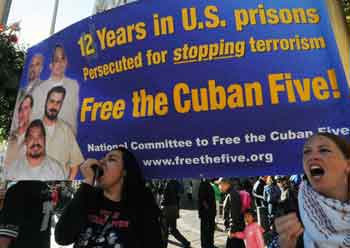
| May 5, 2014 | 9:57 pm | Action, Analysis, Cuban Five, International, Latin America | Comments closed

By James Thompsonzzz-cuban5

The government of the USA and the propaganda mill of the mainstream media shamelessly extol the virtues of being a “Christian nation.” Although portrayed as a heretic by religious zealots, even President Obama frequently quotes Christian Scriptures. President Obama was awarded the Nobel Peace Prize soon after he took office.

Of course, those who study the reality of the political situation in the United States notice that the actions of the US government fly in the face of the main teachings of Christianity.

This paper will first present some well-known quotes from the Bible and then apply them to the stance of the United States government towards one of its closest neighbors, Cuba, and then to the sons of Cuba, the Cuban 5. The Cuban 5 are terrorist fighting heroes who have been persecuted by the US government since 1998 and three of them are still languishing in prison.

First, the quotes from the Bible:

Leviticus 19:18
“‘Do not seek revenge or bear a grudge against anyone among your people, but love your neighbor as yourself.

Matthew 19:19
honor your father and mother,’ and ‘love your neighbor as yourself.'”

Romans 13:8
Let no debt remain outstanding, except the continuing debt to love one another, for whoever loves others has fulfilled the law.

Romans 13:10
Love does no harm to a neighbor. Therefore love is the fulfillment of the law.

Galatians 5:14
For the entire law is fulfilled in keeping this one command: “Love your neighbor as yourself.”

Romans 12:17
…Never pay back evil for evil to anyone. Respect what is right in the sight of all men. If possible, so far as it depends on you, be at peace with all men. Never take your own revenge, beloved…

US foreign policy towards Cuba and the persecution of the Cuban 5

It is clear that the US foreign policy towards Cuba in general and towards the Cuban 5 specifically violates these main biblical teachings. The first quote commands Christians to never seek revenge or bear grudges. Instead, it instructs Christians to “love your neighbor as yourself.” “Love your neighbor as yourself” is a repeating theme throughout all of the quotes above. The US government imposed a vicious embargo, including a travel ban, after the revolution of 1959. The embargo prevents Cubans from obtaining many commodities from the United States. It also prevents the US from obtaining many commodities from Cuba. The embargo is definitely not an expression of “love thy neighbor” but instead is an ugly, hateful policy that hurts both Cuba and the United States. Hate is always destructive. Love is always constructive.

The persecution of the Cuban 5 is similar to the persecution of Jesus Christ, himself. The Cuban 5
were intelligence experts who gathered information on right wing organizations in Miami who plotted and carried out terroristic acts against the working people of Cuba. Many people were killed in Cuba and a great deal of public property was destroyed in the attacks of the right wing counterrevolutionaries. The work of the Cuban 5 thwarted the destructiveness of these deadly attacks. For their noble efforts, the US government threw the Cuban 5 in prison under inhumane conditions and three of them have been there since 1998. Three have been recently released since they completed their terms.

Of course, the persecution of the Cuban 5 by the US government violates all of the Christian teachings cited above. The US government has been condemned around the world for this injustice and human rights violation. The US government has similarly been condemned around the world for its unjust and vengeful embargo and travel ban against Cuba.

What can be done about this awful situation which is an ugly stain on the reputation of the United States of America?

There are two steps that should be taken by the US government in response to the demands of the people of the United States. An overwhelming majority of the US population favors lifting the embargo and travel ban against Cuba. People of conscience overwhelmingly favor returning all of the Cuban 5 to their homes and families.

The government of Cuba has a CIA operative in prison for conspiratorial acts against Cuba. There has been a great deal of talk of swapping this individual, Alan Gross, for the remaining Cuban 5. The people of the United States of America should demand that this move forward so that Mr. Gross can return home immediately. The US people could also demand that other US citizens imprisoned in Cuba be part of the trade. Many US tourists have been arrested for drug activity and other crimes and are in prison in Cuba. It is time for people to demand that the US government negotiate in good faith with the Cuban government for the release of these individuals. Their records should be examined and if returned to the United States, they should be punished for their crimes here, rather than in Cuba.

Medical cooperation between Cuba and the USA

The Cuban government has offered in the past to provide emergency medical care following the devastation of hurricanes in the United States. Cuban doctors are experts in providing this kind of care under very adverse conditions. President Bush declined the humanitarian offer of the Cuban government to provide this kind of assistance following Hurricane Katrina. Instead, people on the Gulf Coast died as a result of a lack of medical care. The people of the United States should demand that in exchange for the return of the Cuban 5 to Cuba, that the US government accept without condition any offers of medical assistance from Cuba following natural disasters.

The Cuban health care system is noted by experts around the world to be one of the most advanced. Cuba has a cooperative relationship with many countries, most notably Venezuela. Cuban doctors work in Venezuela providing health care in underserved areas and train Venezuelan doctors to provide similar care. This is done on contract and Cuba and its doctors are paid by the Venezuelan government to provide this care.

The people of the United States should demand that in exchange for the Cuban 5, the Cuban government enter into a cooperative relationship so that similar services could be provided to underserved populations in the United States. For example, recently there has been a scandal in the VA system. It has come to light that many veterans are dying while waiting for an appointment at the VA. Cuban doctors could help shorten the wait and provide the medical care that US veterans desperately need.

Part of the recently implemented ACA, commonly referred to as Obamacare, was an expansion of Medicaid to working people with incomes too high to qualify for Medicaid and too low to afford to purchase private insurance. Many states, including Texas, declined to cooperate with the expansion of Medicaid. Cuban doctors could be contracted to provide care to this segment of the population that now has no medical coverage.

Cuba has developed many innovative drugs which are not available in this country. These include a drug to fight and prevent cancer, a drug that lowers cholesterol and raises libido, and a drug that treats diabetic ulcers which frequently result in amputations. These drugs could improve the quality of life of many people in the United States.

Let us beat our swords into plowshares, bury the hatchet and make love a major component of US foreign policy, especially towards our close neighbor, Cuba. Let us not cut off our nose to spite our face. What would Jesus do?

PHill1917@comcast.net

Rescuing disposable children in the United States
| April 15, 2014 | 8:44 pm | Action, Analysis | Comments closed

By W. T. Whitney Jr.

Via: http://www.counterpunch.org/2014/04/08/rescuing-disposable-children/

Barbarism, as in Rosa Luxemburg’s “Socialism or Barbarism,” (Junius Pamphlet, 1916 – from Frederick Engels) should be obvious. That’s the case with killings in war, torture, mass incarcerations, or allowing climate change to work its way. But barbarism may also be slow-moving, even hidden. The outlook for many poor, black children in the United States, for example, is so dismal as to suggest that within that society, they are disposable.

Research studies, validated by experience, point to a strong association between growing up poor and non-white and ending up unprepared for schooling and lifelong health. The University of North Carolina’s Abecedarian Project explored that relationship. An update of the Project’s findings appeared in Science recently and was summarized in the New York Times. The findings invite thinking about ways to promote learning and health, in all children.

For 40 years, UNC investigators monitored more than 100 individuals they indentified at birth. They were poor, and 98 percent of them were African – American. Half the babies, randomly selected, entered a “treatment” group. The rest continued on without intervention. From early infancy through age five, over fifty children benefited from skilled, accessible health care and excellent nutrition. Their parents received nutritional education. Importantly, the very young infants entered full-time day care with heavy educational content. At ages six through eight, skilled home visitors provided parents with advice on how to support children’s learning in school. Over many years researchers periodically evaluated both groups from the points of view of learning ability, social adjustment, and eventually adult health.

The Project’s data, just reported, are astounding. The authors conclude: “[W]e find that disadvantaged children randomly assigned to treatment have significantly lower prevalence of risk factors for cardiovascular and metabolic diseases in their mid-30s. The evidence is especially strong for males. The mean systolic blood pressure among the control males is 143 millimeters of mercury … whereas it is only 126 mm Hg among the treated. One in four males in the control group is affected by metabolic syndrome, whereas none in the treatment group are affected.” The term “metabolic syndrome” signifies the presence of at least three of the following: excess abdominal fat, high triglyceride level, low level of “good cholesterol,” high blood pressure, and high blood sugar.

UNC investigators had already reported on other milestones achieved by children in both groups. Remarkably, children with support showed: “higher cognitive test scores from the toddler years to age 21,” higher academic achievement in reading and math from the primary grades through young adulthood, more years in school, higher average age when a first child is born, and higher educational and employment status for mothers of participant children. Twenty three percent of intervention children graduated from a four- year college. Only six percent of children without treatment did so. Young adults benefiting from early intervention were more than twice as likely to be “consistently employed” than the others.

The project’s findings apply potentially to a huge population. In 2012, 23 percent of all U.S. children were living in poverty, defined as a $23,283 annual income for a family of four. And more: 40 percent of black children and 34 percent of Latino children were poor. As reported by the Children’s Defense Fund: “Approximately 1 in 5 Black and 1 in 7 Hispanic children were living in extreme poverty in 2012.” That’s an annual family income of $11,746.

If current patterns of demographic reshuffle continue, the linkage of poverty, non-white ethnic identification, and diminished lives will become even more prominent within U.S. society. In 2013 white children accounted for 53 percent of all children, with Latino and black children representing 24 and 14 percent of the total, respectively. By 2030, white children will have fallen to 45 percent and Latino children will make up 29 percent. The proportion of black children will remain unchanged.

Clarification is in order: effects of racial and class -based discrimination may be inseparable. A study from Maine 30 years ago, for instance, established a correlation between Maine children’s physical vulnerability and low-come status of their families. The mostly white children – identifiable through participation in social welfare programs – claimed a death rate 3.1 times greater than children not receiving such help when they died. “Children from low-income families were at higher risk for disease-related deaths (3.5:1), accidental deaths (2.6:1), and homicide deaths (5.0:1),”

Many commentators see the Abecedarian Project’s data as lending scientific rationale for universal pre-school education, being pushed now – and justifiably so – at high governmental levels. Yet the main thrust of the UNC study was to look at that stage of child development where intervention does the most good.

That would be the first hours, weeks, and months of a child’s life. According to one specialist, “The simple and unavoidable result of this sequential neurodevelopment is that the organizing, ‘sensitive’ brain of an infant or young child is more malleable to experience than a mature brain.” So, the failure of Head Start children’s gains to last throughout the school years may stem from Head Start intervention being too late. The Abecedarian Project corrected that.

But what about those children enrolled in the Project who received no early educational intervention? They, in fact, are stand-ins for millions of other children who end up marginalized. They are victims of low-key barbarism assuring that many children will never develop as they were able to do. As with disasters cited above, their situation is by no means curable within the structure of U.S. and global capitalism. To expect intensive early intervention being extended to millions of U.S. children under current circumstances is wishful thinking.

It turns out, however, that the needs themselves of young children hint at solution. Child development specialists unite in regarding very early, language-based parent- baby interaction as essential for young infants to make gains. This relationship flourishes through mutual gratification. There are rewards on both sides: the baby smiles – does anything – and a parent is overjoyed. The parent holds, caresses, feeds, and talks, and the baby learns someone cares. Messages go back and forth.

Short circuiting is possible. A parent may be too distracted to engage. Indeed, the world of poverty and racial animosity incubates material shortages, unrealized dreams, anger, a siege mentality, failed human relationships, social isolation, sadness, even depression. A baby may bring parents little joy in such circumstances.

One wonders: what if parents, convinced that a better world is possible, found hope? If they did, maybe children would be bathed in warm expectations. What if parents worked to bring about a new world? Their dignity quotient might be up, and their babies would gain. Of course, most children whose parents are comfortable within U.S. society, and are hopeful, and who value themselves don’t need language-based early intervention.

Beleaguered parents would reject their reality of a dog-eat-dog world and join in on fixing things. They would seek a future where basic human needs are assured, where the intellectual, health, and social potentials of all are realized. Confident and optimistic as they work toward socialist goals, they would enter into new exchanges with babies. There would be a boost even just starting out. Quoting the Spanish poet Antonio Machado, progressive Brazilian educator Paulo Freire observed long ago, “We make the road by walking.”

What Really Happened in Ukraine?
| April 4, 2014 | 10:56 pm | Action, Analysis, International | Comments closed

Via: http://mltoday.com/what-really-happened-in-ukraine?utm

By Jack A. Smith

“The West must understand that, to Russia, Ukraine can never be just a foreign country. Russian history began in what was called Kievan-Rus. The Russian religion spread from there. Ukraine has been part of Russia for centuries, and their histories were intertwined before then.

— Henry Kissinger, Washington Post, March 6, 2014

“Ukraine, a new and important space on the Eurasian chessboard, is a geopolitical pivot because its very existence as an independent country helps to transform Russia. Without Ukraine, Russia ceases to be a Eurasian empire.”

— Zbigniew Brzezinski, The Grand Chessboard (1998)

Russia has taught the United States a stern and embarrassing lesson in Ukraine as a riposte to Washington-backed regime change in Kiev, the capital. “So far,” Moscow in effect warned a thoroughly shocked Washington, “but no further.” President Vladimir Putin then annexed Crimea.

Nothing quite like this this move on the geopolitical chessboard has happened since the U.S. became the world’s single superpower over two decades ago.

The objective of the Obama Administration’s support for a coup to remove an essentially neutral Ukrainian government (though neighborly toward Russia) was to install a regime leaning toward — and economically dependent upon — the United States and the European Union. The purpose is to compromise Russia’s revival as a regional power critical of U.S. policies.

The neutrality of the Kiev government, if not close ties, is exceptionally important to Moscow for its own long-term regional goals, and it will work toward repairing relations in time. Considerable support for Russia remains in the country.

Washington was obviously disoriented by Russia’s unexpected move in Ukraine, and perhaps even more so when Putin shrugged off President Obama’s subsequent threats. But for all the anti-Russia rhetoric, sanctions and other punishments emanating from the U.S. and EU, the danger of an armed clash or greatly heightened East-West tensions is relatively remote at the moment, but if the confrontations continue there may be more serious problems ahead.

On March 21, Putin said “he wanted to halt the cycle of tit-for-tat retribution between Moscow and Washington,” according to the New York Times. But it is too early for the self-righteous Obama Administration and Congress to simmer down. Russia in effect challenged the global superpower — an act of supreme lèse-majesté — and this requires considerable posturing, tough rhetoric and a dose of pain from an offended Washington.

From Moscow’s point of view, however, the U.S. and UE made a deep penetration into Russia’s long recognized sphere of influence and Putin had to respond with some degree of equivalence. He easily found it in Crimea.

The U.S. and EU so far have imposed relatively mild sanctions on Russia though warning they would be significantly intensified should Moscow engage in other military moves in Ukraine, which President Putin earlier ruled out. On March 24, the Group of 8 wealthy countries announced it would not invite Russia to future meetings, as least temporarily, and also decided not to attend the scheduled upcoming G8 meeting in the Olympic city of Sochi but will gather at the “G7” in Brussels next June. Russian Foreign Minister Sergei Lavrov said Russia wasn’t disturbed by the development.

Incongruously, the act that provoked the Crimean referendum — the U.S.-backed right wing coup against the democratically elected President Viktor Yanukovich — received far less attention from the American media and hardly any outrage from Washington and most European capitals, even over the fact that organized fascist elements joined the protests leading to the so-called “revolution.”

Washington intrigued to bring about a coup against as punishment for his recent decision to rely on Russian aid and not that offered by the European Union (which was backed by the U.S.) to help bail Ukraine out of a severe economic crisis.

The Ukraine government had been in discussions with the EU to produce a tentative proposal last year. It was short of the country’s needs but better than nothing, even though it also demanded economic, social and infrastructural “reforms” to get the funding. Last fall, Moscow then offered Ukraine an exceptionally generous aid package — a better deal for the government and the working class than the pending proposition from the austerity-minded EU and the conservative International Monetary Fund (IMF).

The entire situation could possibly have been avoided. According to journalist, author and Russia expert Stephen Cohen, interviewed on Democracy Now Jan. 30: “The European Union in November told the government of Ukraine, ‘If you want to sign an economic relationship with us, you cannot sign one with Russia.’ Why not? Putin has said, ‘Why don’t the three of us have an arrangement? We’ll help Ukraine. The West will help Ukraine.’”

The EU and U.S. refused. Our guess is that they wanted to control Ukraine for themselves, not least because it was the most important Soviet republic after Russia itself— a blow to Moscow — as well as a military threat.

Why a coup over this? The White House has long sought to separate Kiev from Moscow since the implosion of the Soviet Union in order to eventually move American power and NATO bases directly up to Ukraine’s Russian border. Washington has been engaged for about two decades in seeking to transform Ukraine into a pro-Western state situated within Washington’s sphere of influence and leadership.

The U.S. thought it achieved its objective when it helped engineer Ukraine’s so-called “Orange Revolution” in 2004, but this victory was short-lived — the victim of infighting and treachery in a basically oligarch-controlled democratic political system that of course still exists. Yanucovich’s election in 2010 was a major turning of the page, and now seems to be turning back.

One proof of Washington’s role in regime change materialized when a secretly taped telephone conversation between Assistant Secretary of State Victoria Nuland, and Geoffrey Platt, U.S. ambassador to Ukraine, appeared on YouTube Feb. 6. The call was made weeks earlier. They were so sure of a coup several weeks ahead that they discussing who would be the U.S. candidate to replace Yanukovich when the day came. There were three possible “moderate Democratic” pro-U.S. choices..

Nuland pushed for Arseniy Yatseniuk, leader of the rightwing opposition Fatherland party, and Platt agreed. Yatseniuk, a 39-year-old banker, lawyer and politician, was named Prime Minister Feb. 27, five days after Yanukovich was ejected. Nuland’s by now infamous “Fuck the E.U.” comment on the tape reflected Washington’s displeasure that the European Union was not moving fast enough to take full advantage of the crisis.

Neoconservative Nuland is evidently managing the current aspect of the State Department’s Ukraine project. In a mid-December speech to the U.S.-Ukraine Foundation, a group dedicated to promoting U.S.-European political and business values in the old homeland — i.e., it’s anti-Russian — Nuland revealed that the American government spent at least $5 billion over the years to turn Ukraine toward Washington. Dozens of U.S.-affiliated NGO’s and government agencies have been engaged in “democracy building” projects in Ukraine over the years, including the United States Agency for International Development, the National Endowment for Democracy, International Republican Institute, the Open Society Foundations, Freedom House, and The National Democratic Institute.

The Obama Administration clearly knew of the important contribution toward regime change made by fascist and neo-Nazi forces involved in the three months of demonstrations against the government following Russia’s aid offer. Nuland and her entourage even attended a mass demonstration, giving out pastries and urging people to keep up the good work. Several top American politicians also dropped by to show support and to appear important. Some — such as Sen. John McCain — allowed themselves to be photographed with fascist leaders.

Secretary of State John Kerry was a frequent visitor to Kiev during the months of anti-government protests, dashing here and there and making pompous pronouncements on behalf of President Obama. Vice President Joe Biden also showed up, no doubt thinking about how the trip will improve his hopeless chances to become the next Democratic presidential nominee. The Nuland tape has her telling Platt she was sending Biden to Kiev to say “ata-boy” to America’s candidate in the Ukraine election.

The White House was mum about the role of the extreme right wing in the protests since it served U.S. interests. The Oval Office also didn’t say a peep about the provisional government’s decision — for the first time in Europe since the Nazi era — to name several fascist leaders to high level positions. It will be of intense interest if these same ultra right groups are again elevated to significant office in the permanent government to be elected May 25.

The fascist groups, mainly Svoboda and the Right Sector, have grown very fast in the last several years. Svoboda won only a couple of seats in the 2006 parliamentary elections, but in 2012 it obtained 37 seats out of 450.

President Obama and leaders of the European Union were blindsided by the Crimea affair. They refuse to accept the astonishingly popular vote, alleging the secession was illegal and that the vote was meaningless because the rest of the country must also vote in such a situation. Considerable hypocrisy pervades the current U.S./EU hand-wringing about territorial integrity, given their own recent conduct, such as:

The province of Kosovo broke away from the Serbian component of Yugoslavia in 1999 with help from a devastating three-month U.S.-NATO bombing campaign that caused heavy damage and many lives in Belgrade, the capital. There was no vote at all for secession by the residents of Kosovo province or throughout Serbia. Washington and the UN then recognized Kosovo’s separation and helped support the territory until it became an independent state. EU entities encouraged and backed this move as they did earlier “assisted” secessions from socialist Yugoslavia. Kosovo now houses Camp Bondsteel, a large U.S./NATO base. In recent years the U.S. has supported the separation of South Sudan from Sudan, Eritrea from Ethiopia, and East Timor from Indonesia.

Regarding the need for an entire country to vote, Canada’s separatist Parti Québécois has participated in different (failed) legal referenda on national sovereignty for the province of Quebec without the rest of the country voting. There are other examples, of course.

The struggle that took place in Ukraine from November until now is extremely complex and in this article we shall look back in history— back to the origins and travail of Crimea, back to Washington’s expensive two-decade effort to lure Ukraine into America’s sphere of influence and to bring it into NATO as well.

First, a word about Ukraine: It is the largest country situated entirely in Europe. If it were a U.S. state it would be third in size at 233,032 sq. mi. The population was 44.3 million, until the 2.2 million people of the Autonomous Republic of Crimea voted to join the Russian Federation. (This includes Sevastopol city, within Crimea but under the jurisdiction of the national capital Kiev, not Crimea’s capital of Simferopol.) Residents of Crimea who wish to retain their Ukrainian citizenship were given 30 days to make their application. Ukraine is an urban, industrialized country that excels in agriculture and is a major exporter of grain and corn. U.S. business interests, primarily Big Agriculture, are deeply invested in the country.

Moscow is far weaker than the U.S but holds some powerful pieces in this geopolitical chess match:

• Russian public opinion strongly supports President Putin and his handling of the Ukraine crisis. Putin’s popularity is usually about 60% but it has jumped to 75.7%, since Jan.1, the highest in five years, according to the VCIOM All-Russian Public Opinion Research Center. RT reports a second poll March 14-15 that showed 91.4% of Russian citizens approve of Crimea becoming a part of the Russian Federation. Only 5% said they were opposed.

In the U.S., CBS reported March 25 that a new poll found “61% of Americans do not think the U.S. has a responsibility to do something about the situation between Russia and Ukraine, nearly twice as many as the 32% who think it does…and specifically 65% do not think the U.S. should provide military aid and equipment to Ukraine in response to Russia’s actions, while only 26% think the U.S. should.” A few days earlier, a Pew Research poll shows that 56% of Americans oppose becoming “too involved in the Ukraine situation.” Those favoring “a firm stand against Russian actions” amounted to 29%. The “don‘t knows” were 15%. Only 8% of the people thought the U.S. should “consider military options.”

What is remarkable here is that most Americans get their information about international affairs from a mass media and government that is one-sided and often deceptive — and still they strongly opposed going to war against Syria a few months ago and now want to keep out of Ukraine. This is quite a change from the public support for the wars in Afghanistan, Iraq, and Libya, drone wars in Pakistan, Yemen and Somalia, subversion and near war against Iran, and potential wars or regime-change in Venezuela, Bolivia and North Korea. The people are weary of war.

• Sanctions aren’t a big worry for Moscow at this point. Russia supplies 30% of the EU’s essential natural gas supply and much oil as well. Russia’s energy sector produces over half of government revenues — and for the next several years at least Europe is in no position to allow sanctions to disrupt this centerpiece of Russia’s economy. Obama is a master at applying sanctions — a virtual qualification for the presidency — but they will cause nothing like the pain being applied to Iran.

In this connection it must be noted that Russia is cooperating with U.S. sanctions against Iran but if Washington and the EU were to significantly increase sanctions or demands on Russia, Moscow could retaliate, in the words of the New York Times March 22, by reviving “plans for a barter deal with the Iranians that would enable them to sell more oil, undercutting the pressure exerted on Iran by Western sanctions.” The Financial Times reported March 25 that in addition Russia could decide to sell Iran the long-range S-300 air defense missile system analysts say “can be a game changer because it would reduce Israel’s ability to attack Iran.”

On March 20 Standard & Poor downgraded Russia’s credit rating from stable to negative, a move that may have been more political than financial. Europe is obviously reluctant to impose strong sanctions and Obama is restrained by objections from U.S. finance and corporate interests that profit from doing business with Russia. So far a number of ranking Russians are being inconvenienced by individual sanctions, travel bans and asset freezes, and Visa/MasterCard owners are out of luck — but the economy, which wasn’t in such good shape to begin with, seems to be remaining stable.

A March 21 report in Politico by Oliver Bullough suggests U.S. sanctions may actually be helping Putin’s several-year campaign to pressure Russian capitalists to deposit their money in Russian, not foreign, banks, where they often hide their assets to cheat tax collection at home. The Russian leader hopes that sanctions and the threat of having their assets frozen will bring more money back to Moscow. Putin has greatly weakened the power of the oligarchs since taking office. Having more of their money in Russian banks empowers state control.

•As a member of the UN Security Council Moscow has an important say (and a veto) in global matters, including those pertaining to Syria, Iran, North Korea and Venezuela — all countries the U.S. seeks to punish or overthrow.

• Russia has many nuclear weapons and adequate delivery systems. After falling apart during the 1990s following the implosion of the USSR, Russia’s armed forces and weapons are now considered sufficient for most challenges. Given this and the Crimean episode, it is now quite doubtful a sober White House will order NATO bases built in Ukraine in the foreseeable future. Halting NATO’s continual advance toward Russia is an existential matter for Moscow. Interim Prime Minister Yatseniuk sought to assure Russia by stating, “association with NATO is not on the agenda.” But Moscow wasn’t born yesterday, and knows today’s agenda could change tomorrow.

As the Soviet Union was beginning to come apart in 1990, Washington promised Soviet President Mikhail Gorbachev — in return for the reunification of Germany — that it would not seek to recruit NATO membership from the impending dissolution of the Warsaw Pact or from the various ex-republics. The U.S. broke that promise right after the USSR imploded 23 years ago.

Years later Gorbachev declared: “They probably rubbed their hands rejoicing at having played a trick on the Russians,” adding this probably is a factor behind Russia’s distrust today.

The anti-Soviet NATO military pact never disbanded and now functions as Washington’s Foreign Legion, fattened by the acquisition of nearly all the former East European members of the Warsaw Pact and three former Soviet republics — Estonia, Latvia and Lithuania.

In 2008, the Bush Administration announced that Ukraine and Georgia were becoming members of NATO. Moscow announced it would not tolerate any such maneuver, and briefly invaded Georgia on the side of separatist South Ossetia and Abkhazia. Washington’s support and intimate involvement in the undemocratic ouster of Yanukovich renewed Moscow’s deep concern about the expansion of NATO to Ukraine, which they would never tolerate any more than the U.S. would Russian troops at the Mexican border.

• Moscow has friends. The 120 member nations of the Non-Aligned Movement have no beef with the Russian Federation. It would hardly be surprising if many of them quietly admired Russia’s chutzpah for standing up to the imperial superpower. A number of other countries are close to Moscow, such as those in Commonwealth of Independent States, Collective Security Treaty Organization or Shanghai Cooperation Organization. The BRICS group of rising economies — Brazil, Russia, India, China and South Africa — is not about to chasten a fellow member of a club that prefers a multilateral world leadership in place of the existing unilateral hegemon. (Incidentally, Harvard history Professor Niall Ferguson wrote this month that the first four BRICS countries will come close within five years to overtaking the four established economic giants: The U.S., UK, Germany and Japan.) China is keeping silent about Ukraine because of its non-interference policy, and it is unenthusiastic about successions, being jittery about Tibet, but if the conflict sharply intensifies Beijing will work to ease tensions, probably siding with Russia in extremis.

Putin’s facilitation of Crimea’s desire for independence from Ukraine was not simply Moscow getting back at Washington for the overthrow of Yanukovich or the desire to protect Russian speakers from the fascist elements, although they were factors. It is also a genuine belief held by most Russians that it is time to bring the Crimean people back home. Further, and this cannot be underestimated, it secured Russia’s prized Navy base.

Without firing a shot, Moscow’s response to regime change was so adept it could have been choreographed by the Bolshoi. On March 11, the parliament of the Autonomous Republic of Crimea adopted a declaration of independence from Ukraine. Five days later a peaceful democratic and honest referendum was conducted in the region and 96.77% voted to return to Russia (see election sidebar). The next day President Vladimir Putin, with overwhelming backing from the Russian people and parliament, annexed the territory.

Only one-third of the Ukrainian soldiers and their families stationed in Crimea are heeding Kiev’s call to return to Ukraine. The remaining two-thirds have opted to stay in Russian Crimea. We don’t know the reasons.

Crimea had been part of Russia since the late 1700s. Soviet Premier Nikita Khrushchev transferred Crimea to neighboring Ukraine in 1954, supposedly to facilitate construction of a huge hydro-electrical project that would supply power to Ukraine and Crimea.

Another motive was noted by former Bush Administration UN Ambassador John Bolton in speaking to a student conference Washington, D.C., Feb. 16. He said Khrushchev “gave the eastern portion and the Crimea to the Ukraine, hoping to water down the still latent Nazism that survived World War II in western Ukraine.” There had been a substantial pro-Nazi movement in the country during the war, part of which fought alongside the Germans and/or against the Russians. Many of Ukraine’s younger fascists today look up to those earlier fighters as heroes.

The people of Crimea, virtually all Russians at the time, were not consulted about the shift and most resented Khrushchev’s decision, though they at least remained in the same Soviet Union, as close to each other as New York to New Jersey. Many longed for Crimea to return to Russia, especially after the union fell apart in 1991.

In 1994 the people of Crimea held their first referendum on separation from Ukraine, and 80% voted for independence but nothing came of it. Twenty years passed before the second referendum, and Crimea returned to Russia.

When Ukraine absorbed Crimea, Russia retained leased rights to the huge strategically important northern Black Sea Fleet base in Crimea, which it has occupied for 221 years. The facility is a geopolitical treasure because it is Russia’s only significant warm water port. Obviously, Moscow was worried that a U.S.-installed regime in Kiev might refuse to renew Russia’s lease. Now this important military facility is safely in Russian hands. (As an aside, Russia’s main warm water port outside its own territory is in the Mediterranean Sea at Tartus in Syria. From the Russian point of view, both strategic bases have been endangered by U.S. imperialism — one by regime change in Ukraine, one by supporting regime change in Syria.)

Serious opposition was aroused in November when Yanukovich rejected the EU-U.S. bailout measure in favor of the Russian aid package. The trouble was mainly in western Ukraine where many citizens identify with Europe, and less so in east and south Ukraine where there is a large population of ethnic Russians, especially in Crimea.

The demonstrations were not so much arguments about the merits of the offer from the European Union, U.S. and International Monetary Fund versus that from Moscow but whether to move toward Europe or Russia. Moscow offered the near-bankrupt Ukrainian government a huge package of aid, including an offer to buy $15 billion of the country’s bonds and reduce the price of Russian gas imports by a third.

President Obama offered a $1 billion loan guarantee, but it is not clear what is coming from the EU and IMF because the situation is changing. Previous offers were considerably lower than Russia’s, and strings were attached.

Within a week 100,000 protesters converged in Maidan Square in a largely peaceful demonstration. There were clashes with police outside the square when breakaway groups smashed their way into Kiev’s city hall, while others tried to crash through police lines to get to the presidential office, resulting in 35 arrests. Hundreds of thousands participated in a protest on Dec. 8.

By now it was becoming evident that the conservative forces in opposition to Yanukovich were losing control of the demonstrations as extreme right wing organizations began setting up a battlefield in the Maidan. By mid-January Kiev appeared under siege and anti-government demonstrators expanded their protests to several cities in western Ukraine, storming and occupying government offices. Parliament then passed anti-protest laws, but they were ineffective. Prime Minister Mykola Azarov resigned near the end January. Parliament rescinded the new laws and passed legislation dropping all charges against arrested protesters if they leave government buildings. In mid-February all 234 arrested demonstrators were released and the office occupations ended.

The real trouble began a couple of days later. Some 25,000 people were in the square when gunfire broke out, killing 11demonstrators and seven police. Hundreds were wounded. It has not been established how it began. Feb. 20 was the worst day of violence when 88 people were killed. The police were largely blamed although there were reports that provocateurs fired at both sides to create even stronger opposition to the government. The next day Yanukovich signed a substantial power sharing deal with opposition leaders, but protests, led by the extreme right, continued and government offices were again occupied. On Feb. 22, as protests continued, Yanukovich “fled for his life,” ending up in Russia.

The coup was completed Feb. 23 when Parliament, including Yanucovich’s Party of the Regions, quickly capitulated to reality and oligarch instructions and voted 328-0 to impeach the president. They then elected Obama’s choice, Yatseniuk, interim Prime Minister.

According to Richard Becker’s article “Who’s Who In Ukraine’s New [Semi-Fascist] Government?” in Liberation newspaper March 6: “The new, self-appointed government in Kiev is a coalition between right-wing and outright fascist forces, and the line between the two is often difficult to discern. Moreover, it is the fascist forces, particularly the Svoboda party and the Right Sector, who are in the ascendancy, as evidenced by the fact that they have been given key government positions in charge of the military and other core elements of the state apparatus.” Here is a list of five fascists in the new government and their positions:

1. Dmytro Yarosh, Right Sector neo-Nazi commander who said “our revival begins with our Maidan,” is now second-in-command of the National Defense and Security Council (covering the military, police, courts and intelligence apparatus).

2. Andriy Parubiy, co-founder of the fascist Social National Party, which later changed its name to Svoboda, is the new top commander of the National Defense and Security Council.

3. Ihor Tenyukh, member of neo-Nazi Svoboda party, was named Minister of Defense, but resigned March 24 over accusations he mishandled the troop withdrawal from Crimea, a charge he denied.

4. Oleksandr Sych, member of neo-Nazi Svoboda, is one of three Vice Prime Ministers.

5. Oleg Makhnitsky, member of neo-Nazi Svoboda, is now Prosecutor-General (Attorney General), and has immediately set out to indict the leaders of Crimea who do not want to live under the new order in Kiev.

Yatseniuk was summoned to Washington and to receive his official elevation from the leader of the free world on March 12. Sitting in the Oval Office chatting with President Obama, he promised he would “never surrender” to Russia. He then paraphrased a famous quote from former President Reagan: “Mr. Putin, tear down this wall, the wall of war, intimidation and military aggression.” Obama and Nuland certainly picked the right man for the job.

Virtually the entire U.S. mass media did not question or critically examine the implications of the White House honoring an unelected prime minister who just replaced a democratically elected prime minister who was overthrown by mass demonstrations that included fascists, some of whom are ending up in the new government. This is an interesting commentary on the condition of American democracy. Ah, the corporate media will reply, “but he was subsequently impeached,” and this makes it all peachy.

The U.S. government dislikes President Putin, especially after Moscow provided the NSA whistleblower Edward Snowden sanctuary in Russia. The antipathy goes back for over a decade. The New York Times published a front page article Feb. 24 headlined “3 Presidents And A Riddle Named Putin.” Former presidents and other leading officials are quoted over the years as characterizing him as cold, or autocratic, or uninformed, or a stone killer, or KGB, or a dictator. Hillary Clinton compared President Putin to Hitler last week, a title Washington usually reserves for political leaders it is about to bomb, though this time it probably was just HRC revving up for 2016.

In reality there are three real reasons for America’s antipathy:

• Russia was a traumatized basket case for a decade after socialism was replaced by robber baron capitalism and forced into an undignified subservience to Washington. Putin took power in 2000 after the abrupt resignation of the by then exceptionally unpopular Boris Yeltsin, who had dissolved the Soviet Union against public opinion. Over the last 14 years as president, premier and president again, Putin’s policies have pulled Russia out of Uncle Sam’s pocket and helped bring the country back to life. James Petras, in a March 11 article, described it this way: “With the advent of President Vladimir Putin and the reconstitution of the Russian state and economy, the U.S. lost a vassal client and source of plundered wealth.”

• He openly criticizes America’s unjust wars and its attempt to dominate the rest of the world.

• He had the effrontery to declare in a 2005 State of the Nation speech to the Russian people: “Above all, we should acknowledge that the collapse of the Soviet Union was a major geopolitical disaster of the century…. Tens of millions of our co-citizens and co-patriots found themselves outside Russian territory. Moreover, the epidemic of disintegration infected Russia itself.”

Putin was being honest. The Russian people certainly understood what he meant — even those who opposed communism. But the neoconservatives who dominated George W. Bush Administration and those of lesser number in the Obama Administration (who happened to be quite active in the Ukraine regime-change operation) remain unforgiving and do their best to demonize the actions and intentions of Russia and its president.

Putin has shortcomings and has made mistakes, of course. He is fairly conservative in general but most pronouncedly in certain social matters that probably coincide with the thinking of a majority of the Russian people. His government’s antagonism toward the LGBT community is about where the U.S. was 30 or 40 years ago and where many Americans still are today. (How many months ago was it when the White House first okayed same sex marriage?) He is also too much a one-man show with an ego as large as Russia.

But the principal aspect of his governance is that he is reviving an independent Russia as a regional power, after a number of post-Soviet years in the doghouse, and that’s what mainly irks Washington.

The New York Times March 25, noting that the Russian president has been complaining for years “about the West moving unilaterally to reorder the Continental balance of power… [Interpreted U.S.-UE] courting of Ukraine… as a step too far, prompting Mr. Putin to risk sanctions and the worst conflict since the Cold War to make clear that Washington and its friends do not call all of the shots anymore.”

It seems impossible for the White House to see the world the way Putin sees it — through Russian eyes that cannot forget the relatively recent past and are wide open to the geopolitical realities taking place today. The Russian president also might think that Washington’s support for Ukraine regime change was an appalling and mocking “thank you” for recently (1) saving Obama’s face by providing him with an exit from an unpopular decision to bomb Syria, and (2) for Russia’s influence on Iran’s leadership that played some role in the recent rapprochement between Tehran and Washington.

The U.S. news media have been asking what nefarious deed to expect next from Russia, and whether Putin plans to grab more territory. It is risky making predictions but this writer’s view the Russian government is going to watch and wait, with no dramatic actions in the immediate future. Russia will try hard to win friends, especially with former republics, to bolster its position against further infringements from Washington. Putin has domestic and other matters on his agenda, including a Eurasian Economic Union. He is flying high after Crimea, Sochi Olympics/Paralympics, super high approval ratings and he’d rather not climb down for a while.

The real question is what the U.S. will do next about Russia and about a very troubled Ukraine, given all the other crises on the crowded agenda of American empire. Obama or his successor will eventually try in one way or another to pay Russia back for Crimea, a deed no self-respecting superpower can simply shrug off. Moscow will be prepared.

The problem for Washington may be its latest geopolitical acquisition. The new Ukrainian government to be elected in May will be utterly dependent on the U.S., its principal enabler and protector, lesser so the EU and the IMF. The economy is in a serious crisis. The IMF austerity program could cause great hardship for working people. The oligarchs will remain oligarchs, richer now because of the business and security the U.S. brings with it.

The country is split into antagonistic factions. Potential trouble can be expected between Ukrainian and Russian speakers. Hot heads will want to retaliate for the loss of Crimea. The fascists have come out boldly and assumed considerable responsibility in overthrowing Yanukovich. They expect a big payoff.

Despite all this, the accomplishment-starved Obama Administration evidently thinks the entire adventure is a big success in that it has just pocketed Ukraine and found an issue with which to throttle Russia for years to come. However, this well may end up far more of a headache than Washington ever imagined. Obama and the Europeans would have been much smarter to accept Russia’s offer of three equal parties sharing the cost of bailing out the Ukraine, and left well enough alone.

The Anti-Cuba Privateers
| March 25, 2014 | 9:51 pm | Action, Analysis, International, Latin America | Comments closed

How Florida Reactionaries Undermine Venezuelan Democracy

by W.T. WHITNEY

http://www.counterpunch.org/2014/03/12/how-florida-reactionaries-undermine-venezuelan-democracy/

Remember the Tonkin Gulf Resolution? In 1964 that joint congressional resolution propelled the United States into war lasting nine years. Resolution 488, passed by House of Representatives by a 393 – 1 vote on March 4, is a moral and practical equivalent. Its title was “Supporting the people of Venezuela as they protest peacefully for democracy, a reduction in violent crime and calling for an end to recent violence.”

The vote took place under a provision known as “suspension of the rules” which Congress uses for “legislation of non-controversial bills.” The sole dissenter was a Kentucky Republican. Republican Ileana Ros-Lehtinen introduced R 488. In Florida she represents the 27th congressional district, part of Miami-Dade County. All but unanimous backing for the resolution is reprehensible – for three reasons.

One, the resolution did not tell the truth. It speaks of Venezuelans “protesting peacefully.” Actually as of March 7 protesters had shot five people dead. Three were soldiers. Six deaths are attributed to opposition roadblocks, 30 more because roadblocks prevented access to emergency services. Soldiers had killed three people, one a government supporter. When protests started in Táchira, Mérida, and Caracas in early February, police did not intervene until government offices and police cars were being attacked and burned and until food and medical supply trucks were blocked. The government arrested officers who violated orders to to act with restraint.

The resolution suggests Venezuela is undemocratic. Over 15 years, however, governments there have won 17 out of 18 national elections. They are elections that for fairness and efficiency are “the best in the world,” according to the Carter Center in Georgia. Press freedom abounds: Venezuela’ predominately privately-owned newspapers and television outlets disseminate opposition viewpoints. Their television broadcasts reach 90 percent of viewers nationally.

Real democracy means uplift for everybody. In Venezuela poverty dropped from 50 percent in 1998 to 32 percent in 2011. Social spending increased from 11 percent of the GDP to 24 percent. Pensioners rose from 500,000 to 2.5 million; people finishing college, from 600,000 to 2.3 million. High school enrollment increased 42 percent. Children malnutrition and infants deaths have fallen dramatically. Every year the minimum wage has increased 10 – 20 percent.

Media misrepresentation contributed to the resolution’s passage. Protesters, for example, hardly represent Venezuela’s majority population. Disturbances have taken place in only 18 of 335 municipalities, places where the middle and upper classes live and where right-wing politicians are in charge. Most students in the streets attend private schools. National polling shows that 85 percent of respondents oppose “protests continuing throughout the country.”

Secondly, passage of Ros-Lehtinen’s resolution is a new chapter in the process of U.S. preparations for undermining Venezuela’s elected government. Money tells some of that story. Analyst Mark Weisbrot reports, “[O]ne can find about $90 million in U.S. funding to Venezuela since 2000 “just looking through U.S. government documents available on the web, including $5 million in the current federal budget.” According to Venezuelanalysis.com: “Over one third of US funding, nearly $15 million annually by 2007, was directed towards youth and student groups, including training in the use of social networks to mobilize political activism.” And, “Embassy cables also reveal US government funding of opposition parties.” Discussing his leadership of the National Endowment for Democracy, a prime source of U.S. funding, Allen Weinstein told the Washington Post in 1991 that “a lot of what we do today was done covertly 25 years ago by the CIA.”

Preparations are evident too from a report produced by Venezuelan – U.S. lawyer Eva Golinger. She alludes to a meeting on June 13, 2013, location unspecified, attended by representatives Colombia’s “Center for Thought Foundation and the Democratic Internationalism Foundation. The two groups have links with ex-Colombian President Alvaro Uribe, right wing protagonist of destabilization in Venezuela. Mark Feierstein, regional head of the US Agency for International Development, attended the meeting.

It generated a document entitled “Venezuelan Strategic Plan,” which detailed 15 “action points.” They included destruction of facilities, “massive mobilizations,” food shortages, and “insurrection inside the army.” The document mentions “crisis in the streets that facilitate the intervention of North America and the forces of NATO, with support of the government of Colombia.” “Violence [causing} deaths and injuries” is anticipated.

The third objection to Ros-Lehtinen’s resolution, and especially to congressional consensus, relates to her associations. She is famous for projecting Cuban-American determination to undo the Cuban Revolution onto the national stage. She thereby bears major responsibility for continuing a national policy of economic blockade of that island. Nor has she challenged her neighbors’ toleration of, even direct participation in, anti-Cuban terrorist attacks. It’s clear now that her neighbors have extended terror attacks to Venezuela, presumably as their contribution to U.S. plans to overthrow Venezuela’s government.

Surely it’s reasonable to expect that U.S. congresspersons, as part of their job description, might ask questions.

They could have inquired about Raul Diaz Peña, who in 2010 showed up in Ros-Lehtinen’s Miami office after having just arrived in the United States. Weeks earlier he had escaped from prison in Venezuela where he was serving time for having bombed embassies in Caracas in 2003. He told reporters on hand that costs for his escape and U.S. entry amounted to $100,000. The congresswoman indicated she “had been lobbying the US government”on his behalf .

On February 23, two days before Ros-Lehtinen introduced her resolution, Robert Alonzo held a “patriotic lunch” for friends at his farm outside Miami. He told them he wanted “help and solidarity of unyielding Cuban – exile combatants in their campaign to step up resistance to [President] Maduro’s misrule.”

Present were Reinol Rodríguez, head of the paramilitary group Alpha 66; José Dionisio Suárez, admitted murderer of ex-Chilean foreign minister Orlando Letelier in Washington; and Armando Valladares, formerly imprisoned in Cuba for bombings and more recently implicated in a plot to kill Bolivian President Evo Morales.

Born in Cuba, Alonso was living in Venezuela until authorities there discovered 153 Colombian paramilitaries lodged at his farm near Caracas. Their plan was to kill then President Hugo Chavez. Alonso helped out with the coup attempt against Chavez in 2002 by leading an assault on the Cuban Embassy.

Another meeting to plan the ouster of President Chavez took place in Miami in 2009. On hand were Jose Antonio Colina Pulido, on the lam after the embassy bombings in 2003; Joaquim Chaffardet, intelligence chief in Venezuela linked to the bombing of a fully loaded Cuban Airliner in 1976, along with Miamian Luis Posada; and Johan Peña, self-exiled after participating in the 2004 murder of Venezuelan prosecutor Danilo Anderson.

Other notable neighbors include: Patricia Poleo, who plotted against Danilo Anderson; military officer Gustavo Diaz, who helped propel the anti-Chavez coup attempt in 2002; and Angel De Fana who tried to kill Fidel Castro in 1997. Former Miami-area FBI head Héctor Pesquera attended a meeting in Panama where final arrangements were made to kill Danilo Anderson.

Finally, R-488 is emblematic of a serious problem relating to the conduct of U.S. foreign policy, specifically privatization. The U.S. government has long farmed out decision-making on and implementation of policies toward Cuba to agents, really proxies, belonging to the Cuban-American émigré community. The same tendency now crops up in regard to Venezuela.

It’s apparent that privateers involved with Cuban affairs, epitomized by Representative Ros-Lehtinen, are promoting a U.S. campaign to undermine Venezuela’s government. Joining this essentially autonomous force are self-exiled, often terrorist-inclined, migrants from other Latin American countries, notably Venezuela. The evidence shows that the milieu where Resolution 488 was spawned nurtures this class of dark characters. That the resolution gained quick, basically unquestioning approval – after all, it was deemed “non-controversial” – is bad news for the future of democracy in both Venezuela and the United States.