Category: Analysis
Terrorism as a weapon of hegemony – The Cuban 5
| June 18, 2014 | 9:21 pm | Action, Analysis, Cuban Five, International, Latin America | Comments closed

Counterpunch

June 17, 2014

Terrorism As A Weapon Of Hegemony

The Cuban Five

by CHANDRA MUZAFFAR

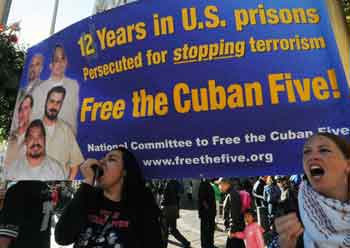
Once again, the International Movement for a Just World (JUST) joins hands with the people of Cuba and justice-loving people in every nook and cranny of the planet, in demanding the immediate release of the three remaining prisoners from the Cuban Five who are still languishing in US jails, after 13 years.

Two were released after completing their prison terms — Rene Gonzales on the 7th of October 2011, and Fernando Gonzales on the 27th of February 2014. It is important to emphasize that they walked to freedom with their dignity intact. The three who are still in jail — Gerardo Hernandez, Antonio Guerrero and Ramon Labanino — deserve our fullest support and solidarity. We should continue to campaign for them with all our heart and soul.

To reiterate, the imprisonment of all five is a travesty of justice. The Cuban Five were monitoring Cuban exile groups in the US in the nineties who had a proven record of committing terrorist acts against the Cuban people. They were gathering information about the terrorist missions that these groups were planning and had informed the US authorities about what they (the Cuban Five) were doing. And yet they were arrested and jailed after an unfair and unjust trial.

If the Cuban Five working under the direction of the Cuban government was determined to expose terrorist activities being carried out against their motherland from US soil, it was mainly because Cuba and its leadership had been victims of US sponsored terror and violence for decades. In 1976, a Cuban commercial plane with 73 passengers on board, a number of them school children, was bombed, killing everyone. The alleged mastermind of this terrorist act, Luis Posada Carriles, is still alive, protected by the US government. There was also an unsuccessful invasion of Cuba by groups in the US in 1961, the infamous ‘Bay of Pigs’ fiasco. A series of terrorist attacks targeting hotels and tourists in the nineties sought to cripple the Cuban economy. And there have been innumerable attempts to assassinate the Leader of the Cuban Revolution, Fidel Castro, right through the 47 years that he was in power. Add to all this the crippling economic sanctions imposed upon Cuba by every US Administration since 1961 and we will get a complete picture of how a small nation of 11 million people has had to endure the terror unleashed against it by its superpower neighbor.

Why has Cuba been the target of terrorism in all its manifestations for so long? The reason is simple. The US elite will not accept in its neighborhood, a nation which is determined to choose its own path to the future without being dictated to, or dominated by, the US. It will not tolerate a people who are committed to defending their independence and sovereignty. To put it in another way, the US drive for hegemony does not permit another nation— especially a nation with a different worldview — to preserve and enhance its dignity.

This hegemonic attitude is borne out by the US’s treatment of other countries in Latin America. Whenever a nation steps out of line, the US line, it is clobbered. Sometimes through terror and violence. Look at Nicaragua, El Salvador, Panama, Uruguay, Ecuador, Bolivia, Brazil, Chile, at different times and in different circumstances. Even in West Asia, terror has been employed to both undermine governments which want to maintain a degree of independence from the US and the West and to create instability and chaos in society. This is the story of Somalia and Sudan, of Libya and Lebanon, of Iraq and Syria. In Southeast Asia too, the Vietnamese, the Cambodians and Laotians have all experienced US terror, just as the people of the Philippines had in the past. Weren’t the citizens of Hiroshima and Nagasaki also exposed to a US “rain of terror” in 1945?

Let’s be clear about this. Terrorism is a tool for dominance and control. Terrorism is a weapon of hegemony. The US — like some other states too—uses this weapon in both ways. It employs terror when it suits its interests. It also fights against terrorism when it serves its agenda. This is why for the US there are “good terrorists” and “bad terrorists.” It is quite happy to collude with the former and crush the latter.

This was obvious in Iraq following the Anglo-American occupation of the land in 2003. In the initial phase the occupier encouraged the Shia militias to fight the Sunni remnants of the Saddam Hussein regime. Once the Shias got into power through the democratic process and moved closer to Iran, the US became worried and backed Sunni militias fighting the Shia dominated government. Now of course, Sunni-Shia clashes, compounded by various other forces, have assumed a life of their own.

In Syria, it is an open secret that the US and other Western and regional actors have been actively involved in supporting the armed rebels against the Bashar al-Assad government in Damascus. Some of the rebels are favored more than others by the US just as other rebels are linked to some of the other external players. The good terrorists from the US perspective receive a lot of assistance including weapons and funds through channels connected to US allies in the region. Are there bad terrorists in the Syrian conflict? While the US may not approve of the tactics used by some of the rebels, it has refrained from strong denunciation of them since it shares their overriding objective of eliminating Assad. So it is Assad who is the bad terrorist in the eyes of the US. Assad is bad because he has been consistent in his opposition to US-Israeli hegemony over West Asia.

There is parallel of sorts to the Cuban situation. All those individuals and groups opposed to the Cuban government, however violent they may be, are good terrorists and have been bestowed with all kinds of aid by US agencies through various conduits. Fidel Castro, and his successor, Raul Castro, are the bad ones. Fidel in particular was demonized in the mainstream Western media as few other leaders had been. Needless to say, it was because of his principled position against US helmed hegemony, articulated with such depth and clarity, that a grossly negative image of the man was disseminated through the media.

But Fidel Castro and the Cuban Five have demonstrated that in the ultimate analysis truth will triumph. Today, Fidel commands a lot of respect and affection among ordinary men and women everywhere for what he has accomplished for his people and indeed for the people of Latin America and the Global South. Similarly, the cause of the Cuban Five has become one of the major rallying-points in the worldwide struggle for human freedom and human dignity because it symbolizes the struggle of the powerless against the powerful.

Dr. Chandra Muzaffar is President of the International Movement for a Just World (JUST), an NGO based in Kuala Lumpur, Malaysia.

http://www.counterpunch.org/2014/06/17/the-cuban-five-2/

Video: “Beyond Obamacare: Why Labor Deserves Better” with Dr. Andrew Coates
| June 16, 2014 | 9:54 pm | Action, Analysis, Labor, National | Comments closed

Video: http://www.youtube.com/watch?v=_M4sP6FieEk&feature=youtu.be

Andy Coates, MD, a former union activist and elected member of the
statewide executive board of his union, the 58,000 member New York State
Public Employees Federation, AFL-CIO, recently spoke in Chicago where his
presentation appeared on Labor Beat, a Chicago area Cable TV program.

Dr. Coates presents a clear overview of the national health care crisis,
the inadequacies of the ACA, and the argument for an ‘everybody in, nobody
out’ Single Payer health program. He gives insight into the basics in
this debate, backed up by selected PowerPoint graphics prepared by
Physicians for a National Health Program (PNHP) and the Illinois
Single-Payer Coalition. Dr. Coates is President of PNHP; Clinical
Assistant Professor of Medicine and Assistant Professor of Psychiatry,
Albany Medical College; Chief of Hospital Medicine, Samaritan Hospital,
Troy, NY; and Medical Director, Albany County Nursing Home.

Dr. Coates concludes that insurers are selling an “unaffordable, defective
product” as he compares the U.S. health care system to other
industrialized countries. We are a nation of increasingly un- and
under-insured, facing staggering household debt from medical bills, and in
particular exposing under-insured children, women, minorities and retirees
to increasing fatality rates and poor health, in order to satisfy a market
solution to health care.

He points to the 2013 AFL-CIO resolution’s “commitment to pursue health
care for all ultimately through a single-payer system” as an important
step forward.

Dr. Coates calls upon the union movement: “I think that for the trade
union movement that if we speak out for what it means for all working
people we’re talking about liberating the whole country here with basic
economic rights, the right to necessary care. Then we find a way forward
for the whole trade union movement. The unions they have the expertise,
they know how to lead us forward, they know exactly how to organize
people, how to fight…and it’s going to take a fight. There’s no
shortcut.”

If your union has not yet endorsed HR 676, please take that first step.

There is a sample resolution here:
http://unionsforsinglepayer.org/tools/sample_resolution

Distributed by:

All Unions Committee for Single Payer Health Care–HR 676
c/o Nurses Professional Organization (NPO)
1169 Eastern Parkway, Suite 2218
Louisville, KY 40217
(502) 636 1551

Email: nursenpo@aol.com
http://unionsforsinglepayer.org
6/16/2014

Elections in Colombia- Peace: 1, War: 0
| June 16, 2014 | 9:04 pm | Action, Analysis, International, Latin America | Comments closed

GRANMA
Colombians re-elected Juan Manuel Santos and his proposal to reach peace through dialogue

Author: International Drafting | internacionales@granma.cu

June 16, 2014 00:06:16

Google translation. Revised by Walter Lippmann.

BOGOTÁ – The Colombian electorate on Sunday scored a goal in the field of betting to return to the warlike policy of former President Alvaro Uribe.

President Juan Manuel Santos won reelection for the period 2014-2018 with the support of 50.9% of the vote, which means that about 4 million 500 thousand voters joined those who had supported his proposals in the first round .

The president focused the final stretch of his campaign in the peace process that maintains in Havana with the Revolutionary Armed Forces People’s Army of Colombia and the exploratory process with the ELN.

In his first speech after the results, Santos said yesterday that the election victory is a mandate of Colombians for peace, who “voted with the hope of changing fear into hope.”

The president-elect said in this election was in the course of playing well understood Colombia and independent sectors, from left, unions, non-governmental organizations that were instrumental in his success.

“We’re going to fix everything that has to be corrected, we will adjust everything to be adjusted and we will restore all that has to be reformed, because that’s what we should bring peace, to implement deep reforms in our country” promised the president.

“I will require the support of the Colombian people,” he said.

Uribismo IS NOT DEAD
The candidate of the Democratic Centre Oscar Iván Zuluaga, who was surprised to win in the first round of voting on 25 May, but who failed to convince the majority with his attacks the Colombian peace process.

However, he enlisted the support of a significant 45% of the electorate went to the polls, which confirms the weight of Uribe’s ghost in the Colombian political scene.

Just minutes after the last newsletter of the Registrar will deliver, Zuluaga recognized the victory of his opponent.

“I feel very proud to have been a candidate for President Uribe of Colombia”, he said in reference to the political affiliation he did not hide at any time. Even made an invitation to that party from now, is better organized as it is “an alternative to Colombia.”

Another was the tone Uribe, head of the Democratic Centre. The current senator did not recognize the election victory, nor did h congratulated the President, whose candidacy Uribe described as the “most corrupt in the history of Colombia.”

Abstention this time was around 52%, lower than in the first round figure, when 6 out of 10 Colombians decided to stay at home, but still worrisome for a country that has major political and social changes to come peace with social justice.
===========================================

GRANMA

Elecciones en Colombia: paz 1, guerra 0

Los colombianos reeligieron a Juan Manuel Santos y su propuesta de llegar a la paz por la vía del diálogo

Autor: Redacción Internacional | internacionales@granma.cu

16 de junio de 2014 00:06:16

BOGOTÁ.—El electorado co­lom­biano anotó este domingo un gol en la cancha de los que apostaban por regresar a la política guerrerista del expresidente Álvaro Uribe.

El presidente Juan Manuel San­tos obtuvo su reelección para el pe­riodo 2014-2018 con el apoyo del 50,9 % de los sufragios, lo que quiere decir que unos 4 millones 500 mil electores se sumaron a los que ha­bían apoyado sus propuestas en la primera vuelta.

El mandatario centró la recta final de su campaña en el proceso de paz que mantiene en La Habana con las Fuerzas Armadas Revolucionarias de Colombia-Ejército del Pueblo y el proceso exploratorio con el Ejército de Liberación Nacional.

En su primer discurso tras conocer los resultados, Santos aseguró ayer que el triunfo electoral es un mandato de los colombianos por la paz, que “votaron con la ilusión de cambiar el miedo por la esperanza”.

El mandatario electo afirmó que en estos comicios estuvo en juego el rumbo de Colombia y así lo entendieron los sectores independientes, de izquierda, sindicales, organizaciones no gubernamentales, que fueron decisivos para su triunfo.

“Vamos a corregir todo lo que haya que corregir, vamos a ajustar todo lo que haya que ajustar y vamos a reformar todo lo que haya que reformar, porque a eso nos debe llevar la paz, a poner en marcha profundas reformas en nuestro país”, prometió el mandatario.

“Requeriré del apoyo de los co­lombianos”, dijo.

EL URIBISMO NO ESTÁ MUERTO

El candidato del Centro Demo­crático Oscar Iván Zuluaga, quien había sorprendido al llevarse la victoria en la primera vuelta de los comicios el 25 de mayo pasado, no logró convencer a la gran mayoría de los colombianos con sus ataques al proceso de paz.

Sin embargo, consiguió el apoyo de un importante 45 % del electorado que asistió a las urnas, lo que confirma el peso del fantasma uribista en el escenario político colombiano.

Tan solo unos minutos después de que se entregara el último boletín de la Registraduría, Zuluaga reconoció la victoria de su oponente.

“Me siento muy orgulloso de haber sido el candidato del uribismo a la Presidencia de Colombia”, refirió en referencia a la afiliación política que no ocultó en ningún momento. Incluso hizo una invitación para que esa colectividad a partir de ahora, se organice mejor ya que es “una alternativa para Colombia”.

Otro fue el tono de Uribe, jefe del Centro Democrático. El actual senador no reconoció el triunfo electoral, ni felicitó al Presidente, cuya candidatura calificó como la de “mayor corrupción en la historia de Co­lombia”.

La abstención en esta ocasión rondó el 52 %, una cifra menor a la registrada en la primera vuelta, cuando 6 de cada 10 colombianos decidió quedarse en su casa, pero aún preocupante para un país que tiene por delante importantes transformaciones políticas y sociales para llegar a la paz con justicia social.
http://www.granma.cu/mundo/2014-06-16/elecciones-en-colombia-paz-1-guerra-0

​USAID & the Cuban Five: Criminalizing counterterrorism, legalizing regime change
| June 16, 2014 | 8:50 pm | Action, Analysis, Cuban Five, International | Comments closed

http://rt.com/op-edge/166192-usaid-cuban-five-terrorism/

USAID & the Cuban Five: Criminalizing counterterrorism, legalizing regime changezzz-cuban5

Nile Bowie is a political analyst and photographer currently residing in Kuala Lumpur, Malaysia. He can be reached on Twitter or at nilebowie@gmail.com

June 16, 2014 09:37

The plight of five imprisoned Cuban counterterrorism officers, known collectively as the Cuban Five, has been the subject of a growing campaign to lobby Congress in favor of releasing the men.

The five officers were monitoring Cuban exile groups based in Miami with an established track record of orchestrating terrorist acts inside Cuba. The group had informed US authorities of their actions, and were not in possession of any weapons, nor did they engage in any act of espionage against the US or cause harm to any person.

In September 1998, the five officers were arrested by FBI agents and were accused of conspiracy to commit espionage. Their trial, which lasted over six months, became the longest in US history. Though the group was never directly accused of espionage, nor were any acts of espionage committed, the five Cuban men were sentenced to a total of four life sentences plus 77 years.

No fair trial

The men were initially kept in solitary confinement for 17 months, and were later imprisoned in five separate maximum-security prisons spread across the US without the possibility of communication with each other. Their case represents the first time in US history that life sentences were meted out on espionage charges.

The consensus among various legal experts and advocacy groups is that political and partisan considerations worked against justice and the five Cuban men were not given a fair trial. The trial was held in Miami, a region that is synonymous with maintaining open hostility toward the Cuban government, making it incredibly difficult to seat an impartial jury in such a politically charged atmosphere.

According to reports, the US government commissioned several Miami-based journalists to write negative stories to discredit the five defendants, which were widely publicized to influence public opinion. Moreover, the US government even recognized in writing that it was unable to substantiate the conspiracy to commit murder charges against Gerardo Hernandez, one of the five defendants.

During the lengthy appeals process, a three-judge panel in 2005 overturned all of the convictions on the grounds that the defendants had not received a fair trial in Miami, but Washington pressured the Court of Appeals in 2006 to reverse the decision.

The UN Working Group on Arbitrary Detention also concluded that the imprisonment of the group was arbitrary, and urged the US government to correct the situation. Despite dissenting opinions from judges in the Court of Appeals, the US Supreme Court intervened in 2009 to announce its decision not to review the case of the five Cuban nationals, despite strong arguments made by their defense attorneys.

Who’s fighting terrorismCuban five

The predicament facing the Cuban Five is relevant not just on the basis that these men were denied justice, but that their detention is a result of the group’s efforts to thwart terrorist activities carried out by Cuban exile groups with the support and collusion of US intelligence agencies.

Cuba has faced terrorist activities for decades, in addition to attempted US military invasions and numerous assassination attempts upon its former President, Fidel Castro. The vast majority of bomb attacks and other terrorism that has historically afflicted Cuba originate from southern Florida, carried out by Cuban-exile groups that are tolerated and partly financed by the US government.

A series of bombings swept through Havana in 1997 targeting hotels, restaurants, bars and clubs. Cuba dispatched the five officers who would later be arrested and given life sentences precisely because they intended to monitor the suspected culprits of the bombings who were based in Miami. The men were arrested and charged despite their attempts to share information with the FBI in the hope that they would assist in clamping down on violent right-wing exile groups.

The string of bombings was later confirmed to be orchestrated by Luis Posada Carriles, a Cuban exile and former CIA asset. Carriles moved to the United States after the Cuban revolution and helped to organize the failed invasion at the Bay of Pigs; he was later trained by the CIA in sabotage and explosives, becoming a key figure among the exile community for orchestrating anti-Castro activities.

Carriles admitted his involvement in the 1997 bombings in Havana, and was convicted in absentia in Panama for bombing a Cuban airliner in 1976 that killed 78 civilians. Despite warnings from the US Justice Department, Carriles was allowed to remain in the United States and was acquitted of all charges in 2011, allowing him to continue living comfortably in Miami.

Foreign affairs logic

The Cuban government has consistently campaigned for the release of the five men over the last fifteen years. Two of the men, René González and Fernando Gonzalez, were allowed to end their sentences early, in October 2011 and February 2014 respectively. The three other men received much harsher sentences; Antonio Guerrero will be released in September 2017, while Ramón Labañino’s release is scheduled for October 2024. Gerardo Hernandez faces to two life terms plus 15 years of imprisonment.

In an effort to release the three remaining men, Havana has repeatedly offered to begin negotiations with the Obama administration on a possible exchange of their three remaining agents for Alan Gross, an American contractor currently serving a 15-year sentence in Cuba for smuggling illegal satellite communication equipment into the country as part of a US Agency for International Development (USAID) democracy promotion program initiated under the Bush Administration.

Gross smuggled laptops, smartphones, hard drives, networking equipment, and satellite communications equipment into the country, which he claimed was only designed to facilitate internet access for the small Jewish community in Cuba. Upon his detention, Gross was found to be carrying a specialized SIM card not available on the open market and is distributed only to governments that experts say is often used by the Pentagon and the CIA to mask satellite signals to avoid being tracked.

Havana sentenced Gross to 15 years in prison for smuggling and encouraging “acts against the integrity”of the state in December 2009. The Cuban authorities view the operations of USAID as attempts to foment regime change and consider such programs to be an affront to its sovereignty. Washington has refused even to provide operational details of its USAID projects in Cuba to various congressional committees charged with overseeing the program, which operates with a massive $20 million budget

The Obama administration recently set a precedent by swapping five members of the Taliban who were detained in Guantánamo Bay for Army Sgt. Bowe Bergdahl, an American solider imprisoned in Afghanistan. When asked at a recent press conference, US State Department spokesperson Jen Psakidismissed the possibility of a prisoner swap that would free the three remaining Cuban officers in exchange for Gross.Cuban five UN

The rationale for the Obama administration’s decision to swap members of the Taliban for Bergdahl was allegedly an expression of the principle that soldiers are not left behind on the battlefield. Dozens of American senators have called on President Obama to take whatever steps are in the national interest to free Gross, while members of the Gross family have criticized Washington for all-but abandoning the detained American contractor and lacking the political will to compromise with Havana to secure his release.

In the midst of the Obama administration’s lax efforts to get Alan Gross released from detention, USAID found itself muddled in a scandal that exposed the agency’s failed attempt to engineer a Twitter-like text messaging network in Cuba with the aim of spreading information tarnishing the reputation of the Cuban government, ostensibly with the aim of igniting anti-government sentiments.

The unjust imprisonment of Cuban officers is the biggest impediment to an improvement in relations between Washington and Havana, and the precedent is now set to for a common sense prisoner swap that would be mutually beneficial for both sides. If the Obama administration is comfortable with releasing five former Taliban fighters to free an American, there should be no question about freeing the three remaining Cuban counterterrorism officers.

Despite calling for better relations with Cuba during his 2008 campaign, the Obama administration has not deviated from the harassment and regime change policies undertaken by consecutive US administrations. The injustice meted out to the Cuban Five is a testament to Washington’s infinite capacity for embracing double standards, as counterterrorism operations are criminalized while anti-Castro terrorists walk free.Free the Cuban 5

The statements, views and opinions expressed in this column are solely those of the author and do not necessarily represent those of RT.

Discurso pronunciado por el General de Ejército Raúl Castro Ruz
| June 16, 2014 | 8:42 pm | Action, Analysis, International, Latin America | Comments closed

Discurso pronunciado por el General de Ejército Raúl Castro Ruz, Presidente de los Consejos de Estado y de Ministros, en ocasión de la Cumbre del Grupo de los 77 más China

Agradezco al compañero Evo Morales Ayma, Presidente y destacado representante de los pueblos originarios de nuestra región, la convocatoria de esta importante Cumbre…

Autor: Consejo de Estado | internet@granma.cu

15 de junio de 2014 17:06:47

(Versiones Taquigráficas – Consejo de Estado)

Compañero Evo Morales Ayma, Presidente del Estado Plurinacional de Bolivia y Presidente del Grupo de los 77 más China:

Excelencias:

Agradezco al compañero Evo Morales Ayma, Presidente y destacado representante de los pueblos originarios de nuestra región, la convocatoria de esta importante Cumbre.

Al término de la Primera Conferencia de Naciones Unidas sobre Comercio y Desarrollo, en junio de 1964, un grupo de países en desarrollo, conscientes de los enormes desafíos que tendrían que sortear, decidió marchar unido para hacer frente a un sistema económico mundial que desde entonces se manifestaba desigual e injusto.

A este grupo se debe la preparación, negociación y aprobación, el primero de mayo de 1974, hace ya 40 años, de uno de los documentos programáticos más importantes en la lucha contra el subdesarrollo y por el logro de la justicia económica internacional: la Declaración y el Programa de Acción para el Establecimiento de un Nuevo Orden Internacional, (y cito), “basado en la equidad, la igualdad soberana, la interdependencia, el interés común y la cooperación de todos los Estados, cualesquiera sean sus sistemas económicos y sociales, que permita corregir las desigualdades y reparar las injusticias actuales, eliminar las disparidades crecientes entre los países desarrollados y los países en desarrollo y garantizar a las generaciones presentes y futuras un desarrollo económico y social que vaya acelerándose, en la paz y la justicia (…)”. (Fin de la cita).

Poco después, logró la aprobación de la Carta de Derechos y Deberes Económicos de los Estados, que consagra el ejercicio de la soberanía de los Estados sobre los recursos naturales y la actividad económica en su territorio.

Esos importantes documentos mantienen plena vigencia, pero la gran paradoja es que hoy no se quiere hablar de ellos. Se les califica de “atrasados” y “superados por los hechos”.

Sin embargo, ahora se amplía la brecha entre el norte y el sur, y una profunda crisis económica global, resultante del irreversible fracaso del neoliberalismo impuesto desde los principales centros de poder, con un impacto devastador para nuestros países, se ha convertido en la más larga y compleja de las últimas ocho décadas.

Cuando casi concluye el ciclo previsto para los Objetivos de Desarrollo, acordados en la Cumbre del Milenio del año 2000:
•Mil doscientos millones de personas en el mundo viven en la pobreza extrema. En África subsahariana, el número de pobres ha aumentado ininterrumpidamente, pasando de 290 millones en 1990 a 414 millones en el 2010.
•Una de cada ocho personas en el mundo sufre de hambre crónica.
•El 45% de los niños fallecidos antes de cumplir los cinco años, muere por malnutrición.

•La deuda externa registra niveles sin precedentes, a pesar de los enormes pagos que hemos realizado por su servicio.
•Se agrava el cambio climático, generado -en lo fundamental-, por los patrones de producción y consumo irracionales y derrochadores de los países industrializados que, de mantenerse, para el 2030 harían falta recursos naturales equivalentes a dos planetas.

Ante estas realidades, conserva plena vigencia el principio de las responsabilidades comunes, pero diferenciadas en el enfrentamiento del cambio climático y otros desafíos ambientales.

Como ha dicho el compañero Fidel Castro Ruz, “Existen los recursos para financiar el desarrollo. Lo que falta es la voluntad política de los gobiernos de los países desarrollados.”

Es preciso exigir un nuevo orden financiero y monetario internacional y condiciones comerciales justas para productores e importadores a los guardianes del capital, centrados en el Fondo Monetario Internacional y el Banco Mundial, a los defensores del neoliberalismo, agrupados en la Organización Mundial de Comercio, que intentan dividirnos.

Solo la unidad nos permitirá hacer prevalecer nuestra amplia mayoría.

Así tendremos que hacerlo si queremos que la Agenda de Desarrollo después del 2015, que deberá incluir los Objetivos de Desarrollo Sostenible, ofrezca respuestas a los problemas estructurales de las economías de nuestros países, genere cambios que permitan proponerse un desarrollo sostenible; sea universal y responda a los diferentes niveles de desarrollo.

Compañero Presidente:

En la actualidad, se transgrede la soberanía de los Estados, se violan de forma descarnada los principios del Derecho Internacional y los postulados del Nuevo Orden Económico Internacional, se imponen conceptos que intentan legalizar la injerencia, se usa la fuerza y se amenaza con su uso de manera impune, se utilizan los medios para promover la división. Todavía resuena en nuestros oídos aquella amenaza contra “60 o más oscuros rincones del mundo” del presidente de Estados Unidos George W. Bush, obviamente, todos países miembros del Grupo de los 77.

Debemos ejercer nuestra solidaridad con aquellos a quienes se amenaza con la agresión. Hoy, el caso más nítido es la República Bolivariana de Venezuela, contra la que se emplean los medios más sofisticados de subversión y desestabilización, incluidos los intentos de golpe de Estado, según las concepciones de la guerra no convencional que Estados Unidos hoy aplica para derrocar gobiernos, subvertir y desestabilizar sociedades.

Por más de 50 años, hemos sido víctimas de un genocida bloqueo norteamericano; de acciones terroristas que han costado la vida a miles de nuestros ciudadanos, y provocado cuantiosos daños materiales. La absurda inclusión de Cuba en la lista de “Estados Patrocinadores del Terrorismo Internacional”, es una afrenta a nuestro pueblo.

Como hemos denunciado, es creciente la promoción de acciones ilegales, encubiertas y subversivas, así como el uso del ciberespacio para intentar desestabilizarnos, no solo a Cuba, sino a países cuyos gobiernos no aceptan injerencia ni tutelaje. De esta forma, cualquier nación puede ser objeto de ataques informáticos dirigidos a fomentar la desconfianza, la desestabilización y conflictos potenciales.

Durante todos estos años, siempre nos ha acompañado la firme solidaridad de los miembros del Grupo de los 77 más China, lo que agradezco en nombre del pueblo cubano.

Aprovechemos este 50 aniversario del Grupo de los 77 para renovar nuestro compromiso común de concertar esfuerzos y estrechar filas para construir un mundo más justo.

Muchas Gracias (Aplausos).

The Collapse of the Soviet Union Reconsidered
| June 15, 2014 | 7:12 pm | Action, Analysis, International | Comments closed

http://mltoday.com/the-collapse-of-the-soviet-union-reconsidered?utm

The Collapse of the Soviet Union Reconsidered

by Roger Keeran and Thomas Kenny

In 2004, Thomas Kenny and I wrote Socialism Betrayed: Behind the Collapse of the Soviet Union. Since 2004, the book has been published and reviewed in Bulgaria, Russia, Iran, Turkey, Greece, Portugal, France, Cuba and Spain. One or both of the authors have been present for discussions of the book in Greece, Portugal, France and Cuba, and a number of critics have reviewed the book in leftwing journals. In this presentation, Kenny and I will respond to two criticisms and one question prompted by the book. In the book, we put forth an explanation for the collapse of the Soviet Union. We used the words “collapse” and “betrayal” in the title in spite of the possible misleading connotations of both words.

Still, there was no doubt as to what we were trying to explain, namely the radical transformation that displaced the political power of the Communist Party of the Soviet Union, abolished most state ownership, centralized planning, and the system of social services, and fragmented the multi-national state. We argued that the Soviet Union did not collapse because socialism failed. Rather, the system of socialism based on collective or state ownership of property and state planning proved a remarkable success, particularly from the point of view of working people. The system proved itself capable of providing sustained economic growth over six decades, notable technical and scientific innovations, unprecedented economic and social benefits to all its citizens, all the while defending itself from external invasion, sabotage, and threats, and offering economic aid, technical assistance, and military protection to other nations struggling for independence and socialism.

The Soviet Union nonetheless had problems—some related to political and ideological ossification, some related to the quantity and quality of its economic output, and some related to the ongoing struggle with imperialism. These problems, however, did not cause the system’s collapse. What brought down Soviet socialism were the policies pursued by Mikhail Gorbachev. These policies emanated from a belief that the problems of socialism could be solved by making unilateral concessions to imperialism and by incorporating into socialism certain ideas and policies of capitalism. Gorbachev’s ideas had roots in Soviet political discourse, but they had never triumphed so completely as they did under Gorbachev.

What allowed these ideas to gain ascendancy was that in the previous thirty years a petty bourgeois sector rooted mainly in the illegal, private economy had developed within the Soviet Union. This so-called second economy had damaged the first economy, demoralized some of the population, corrupted segments of the Communist Party and government, and provided a social basis for the policies pursued by Gorbachev. Instead of curing the problems of socialism, Gorbachev’s policies in short order wreaked complete economic havoc and eventually toppled socialism.

Criticism #1

Some critics maintain that our explanation ignores a deep reason for the collapse, namely that the attempt to build socialism in the Soviet Union was doomed from the beginning by the insufficient development of the productive forces.

This is not a new idea. In 1918, Karl Kautsky had said that Russia was not ready for socialism. This idea drew on Karl Marx and Frederick Engels who believed that only the full development of the productive forces under capitalism would create the pre-conditions for the abolition of classes and on Engels’s description in 1875 of the backwardness of Russia. According to this view, the Soviet Union could have moved to socialism only by first allowing private enterprise to flourish and by developing the productive forces by joint ventures with foreign capitalists, both of which would have happened if the Soviet Union had continued the so-called New Economic Program (NEP) which Lenin introduced in 1921. A corollary of this idea was that the Soviet Union could only have avoided a collapse by pursuing the path of China and Vietnam today, the path of “a market economy with socialist orientation.”

Major problems exist with this explanation. It is not at all clear what Marx and Engels would have thought was the appropriate course for Soviet Communists in the 1920s. Though the Soviet conditions may not have been ideal to build socialism, Marx was well aware, as he said in 1853, that “men make their own history, but they do not make it just as they please; they do not make it under circumstances chosen by themselves, but under circumstances directly encountered, given and transmitted by the past.”

Moreover, in 1917 Russia was not quite so backward as the country described by Engels in 1875. It possessed some of the largest industrial factories in the world, and 10 percent of its population worked in industry. Admittedly, the new Soviet Union remained a mainly peasant country, and Soviet leaders like Viacheslav Molotov later acknowledged that backwardness “adversely affected socialism.” Nevertheless, those who think backwardness not only adversely affected socialism but doomed it must confront three challenges. First, however backward the Soviet Union was in the early 1920s, it did not remain so. Having the advantage of rich natural resources, a resourceful leadership, and a motivated population, the Soviet Union steadily overcame its backwardness. By the 1980s, the Soviet Union had become an economic power second only to the United States. In 1984 the economist Harry Shaffer wrote: “The United States is still ahead of the Soviet Union in total and per capita output, in consumption, and in living standards. But the Soviet Union has been steadily gaining on the United States.”

So, even if the productive forces started in a state of underdevelopment, they hardly remained there by 1985. While Soviet industrial development could not be disputed, some believed that the original backwardness nonetheless fatally weakened the system. Erwin Marquit asserted that the original backwardness led the Soviets to resort to “the utopian model of a centrally planned economy” and that the centrally planned economy “proved unable to match the pace of market-driven technological development in the West.” This is not convincing. Indeed, the exact opposite was true. Through state ownership and planning, the Soviet economy made remarkable strides not only economically but also technologically. By the 1980s Soviet technological development did not equal that of the U.S., but it remained not far behind and was gaining. In a book on socialist science and technology published in 1989, John W. Kiser III argued that the whole idea of a “technology gap” was an overstatement born of “America’s belief in the inherent inferiority of the Soviet system.” Because the Soviet system lacked an incentive to commercialize its technological achievements, the West had “a persistent tendency to underestimate them.” Kiser pointed to technological breakthroughs the Soviets and eastern Europeans made in metallurgy, chemistry, food processing, biomedicine and elsewhere.

As for computer technology, in 1986 the CIA concluded that a software and hardware gap existed between the Soviet Union and the West, but that “the Soviets will still be making rapid progress in absolute terms” and that in ten to fifteen years “the top Soviet scientific institutions will probably have equipment comparable to that of the best US national laboratories at present.” In other words, technological gaps were small and narrowing. Thus, technological backwardness hardly provided a compelling explanation of the collapse. A second problem with the backwardness explanation was its assumption that the New Economic Program (NEP), i.e. fostering development through encouraging private enterprise and foreign investment, provided a live option. This was like arguing that the American Civil War could have been avoided had the North simply allowed slavery to die out naturally. Though this idea may appeal to those who wanted to blame the abolitionists for the carnage of the Civil War, few, if any, historians think that was a live option in 1860. Similarly, sticking with the NEP did not represent a live option for the Soviets in the 1920s. In 1921, the Soviets had turned to the NEP to deal with problems created by the policies of “war communism,” particularly the alienation of the peasants caused by the confiscation of their grain. In a short time, however, the NEP developed its own problems.

In explaining why the Soviets abandoned the NEP, the historian E. H. Carr pointed to three grave problems. First, in 1922-23, the so-called “scissors” crisis occurred, in which wildly fluctuating grain prices led to food shortages, unemployment and the suffering of poor and middle peasants. Second, most Soviet leaders came to realize that the NEP condemned the Soviet Union to a long period of industrial backwardness, and this was a fearsome and intolerable prospect in the face of the growing threat from external enemies. Third, in 1927-28 falling agricultural prices caused peasants to hoard their produce creating starvation in the cities. For these reasons, reliance on the market and private incentives became untenable. Thus, real economic problems, as well as ideological preferences, compelled Soviet leaders to adopt new policies and to embrace public ownership and centralized planning. Under these circumstances, to call the Soviet move to state ownership and central planning “utopian” is preposterous. By making this move the Soviets industrialized quickly, defeated the Nazi invasion, and rebuilt quickly after the war.

Moreover, they did so while steadily increasing the standard of living of Soviet workers. To imagine that the Soviets could have achieved the same results by continuing the problematic policies of the NEP constitutes wishful thinking in the extreme. The backwardness explanation of the Soviet collapse contained a third weakness. This weakness is exposed by examining the lessons inferred by this explanation. It is entirely appropriate to judge an explanation by its lessons. For example, if a shepherd died by falling off a mountain cliff, only a fool would draw the lesson that people must avoid sheepherding and mountains. If, however, at the time of the accident, the shepherd was drunk, a reasonable person would draw the lesson that one should avoid drinking while tending sheep on mountain cliffs. Some who subscribe to the backwardness explanation of the Soviet collapse, drew the lesson that the Soviet Union should have avoided central planning and followed the path of China. But this lesson was no more reasonable than that of avoiding sheepherding or mountain climbing. At the very least, this conclusion is rash. Not even the Chinese themselves draw this conclusion from the Soviet collapse. According to Arthur Waldron, “Today’s official China believes that nothing deep or fundamental was wrong with the Soviet Union even in the late 1980s. According to the official narrative, the failure of the Soviet regime to continue is not attributable to a broad systemic phenomenon, but rather to a very specific failure of the Communist Party of the Soviet Union.”

Moreover, where the Chinese path will ultimately lead and what it will mean for the working class remain open questions. In the short run, the Chinese path has produced economic growth and increased income for the urban population. Nonetheless, since 2008 both the decline of economic growth rates and the entanglements of the Chinese economy with a stagnating world market cast doubts about this model’s continued viability. According to the New York Times in March of this year, China’s “growth has decelerated to its slowest pace in more than a decade.”

Moreover, the Chinese working class is paying a high price for a path that steadily diverges from socialist goals. For a decade, unofficial urban unemployment has consistently been over 8 percent. Foreign ownership and investment as a share of total manufacturing sales in China has gone from 2.3 percent in 1990 to 31.3 percent in 2000. Since direct foreign investment in China ($124 billion in 2011) has been increasing yearly and is now second only to the United States, the percentage of foreign ownership is undoubtedly much greater now than in 2000. Moreover, according to a recent study, “the inevitable outcomes of China’s capitalist development” has included “growing unemployment, inequality, and insecurity; the cutbacks in communal health care and education; worsening oppression of women; the marginalization of agriculture; and the multiplication of environmental crises.” To the extent that a market economy with a socialist orientation remains a dubious path to socialism, so it remains a dubious lesson to draw from the Soviet collapse.

In sum, the backwardness explanation must be rejected for three reasons. First, however backward the Soviet Union was in 1917, the productive forces did not remain undeveloped by 1985. Second, the explanation implied that the Soviet Union should have and could have continued the NEP. This idea was untenable at the time and is entirely fanciful in retrospect. Third, whether the Chinese path to socialism is more reliable than the Soviet one remains to be seen.

Criticism #2

A second criticism of our book arose from the treatment of Joseph Stalin. For some critics, the failure to denounce Stalin as a paranoiac, a criminal, an anti-Semite, a demon, a dictator and a mass murderer, constituted a fatal flaw. For some critics nothing would have been satisfactory short of subscribing to what Domenico Losurdo calls “une legende noire.” For some critics, our failure to condemn the cruelty under Stalin was an unpardonable omission. To this we would like to respond as Lenin did when Maxim Gorky’s expressed concern about “the cruelty of revolutionary tactics.” Lenin said, “‘What do you want?….Is it possible to act humanely in a struggle of such unprecedented ferocity? Where is there any place for soft-heartedness or generosity? We are being blockaded by Europe, we are deprived of the help of the European proletariat, counter-revolution is creeping like a bear on us from every side. What do you want? Are we not right? Ought we not to struggle and resist? We are not a set of fools….What is your criterion for judging which blows are necessary and which are superfluous in a fight?”

The truth is that we did not provide an overall assessment of Stalin, because we thought it too important to do in a cursory fashion in a study devoted to something else. As any historian, we raised a specific question—in this case the causes of the Soviet collapse—and confined ourselves to trying to answer it. We dealt with Stalin’s ideas and policies only as they related to our explanation.

To the extent that criticism of our treatment of Stalin relates to our explanation of the collapse, it deserves a response. Here a distinction must be made. As is well-known, a line of thought stretches from the 1920s to the present that socialism in the Soviet Union began an inexorable decline ever since it rejected the ideas of Leon Trotsky on the need to pursue a permanent, worldwide revolution and the futility of trying to build socialism in one country. From this point of view, the Soviet Union did not constitute socialism, and its collapse represented no more than a footnote to the exile of Trotsky. Only those who accepted these premises about the importance of Trotsky and the lack of socialism in the Soviet Union (which are really more political than historical judgments) could be satisfied by a Trotskyist explanation of Soviet history.

There are, however, other views of Stalin and his role in the Soviet collapse. One such view claimed that the Soviet collapse resulted from a “Stalinist deformation,” a kind of delayed result of Stalin’s policies. This view held that the Soviet Union built a socialist society based on public ownership and planning that worked well at delivering economic growth, securing military defense, and providing employment, economic security, health care, education and a high cultural level for workers. Nevertheless, coping with its own backwardness and with internal and external threats as well as other challenges led to anti-democratic deformations. These deformations took the form of “the cult of the individual personality, the authoritarian incorporation of all social activity under the disciplined control of the CPSU, and the subordination of all scientific and cultural thought and practice to political ideology.”

According to this view, a planned economy presented no problem in the Soviet Union, rather the problem resided in a legacy of Stalin’s authoritarianism. Stalin’s authoritarianism undermined attempts to decentralize control and responsibility, sapped initiative, and kept the socialist economy from realizing its potential. Anyone casually acquainted with the Western historiography of Stalin and the Soviet Union would hardly be surprised that some would blame him for the collapse of the Soviet Union, since one writer or another has held him responsible for nearly every calamity of the twentieth century. Any figure as complex as Stalin, the leader of a vast country going through numerous crises over an extended period of time, was bound to leave a complicated legacy. Thus, one can readily grant the existence of the problems adduced by those who hold the theory of Stalin deformation. For example, in a planned economy where the nature and size of production are set from above, there is an endemic problem of stifling initiative and responsibility below. The Soviet Union grappled with this problem for years, and Cuba grapples with it today. This problem did nor uniquely result from Stalin. Moreover, without giving them the name Stalinist deformation, we acknowledge that the size and methods of the repression “undoubtedly left a legacy of bitterness, timidity, servility, shame, and heaven knows what else.”

That, however, is not the end of the story. In evaluating Stalin’s legacy, one must distinguish between moral and political judgments—that is, whether certain behavior or policy was good or bad, justified or unjustified, positive or negative—and historical judgments about causation and consequences. Both kinds of judgment have a legitimate place, but the question before us is a matter of historical judgment. That is: did Stalin’s policies actually figure in the Soviet collapse? Frankly, those who hold the Stalin deformation view have done little to move the discussion from moral outrage to historical explanation. Stalin left a contradictory legacy on the question of authoritarianism and democracy. Those who subscribe to the Stalinist deformation explanation see only one side, that Stalin undermined socialist democracy and demoralized and demobilized the Soviet people and that this ultimately undermined the efficiency and productiveness of the socialist system and hence led to the collapse. But where is the evidence of this demoralization and demobilization? The great accomplishments of the Soviet people between 1930 and 1950, the collectivization of agriculture, the rapid industrialization, the raising of the educational and cultural level of the people, the defeat of Hitler’s invasion, the reconstruction of the country in four years after the devastation of the war, hardly suggested the work of a demoralized and demobilized population. The very opposite. These achievements required active, popular participation. Moreover, a clear-eyed view of Stalin’s legacy must admit that it contained elements of democracy and popular participation as well as autocracy and repression. The Soviet Constitution of 1936 symbolized this ambiguous legacy.

On the one hand, despite the Constitution’s democratic promises, the Soviet Union would remain a state where power was concentrated in the Communist party and increasingly in the leader of that party, where nominations for office and other initiatives came from the top, and where other institutions including the Soviets and trade unions served a consultative and implementing function at best. On the other hand, the Constitution represented an attempt for the first time in history, and under unfavorable circumstances, to give meaning to the idea of socialist democracy. The Constitution resulted from a two year process of discussion that involved large segments of workers, peasants and others in a nationwide debate of a draft document followed by a national referendum. The Constitution expanded the democratic rights of Soviet citizens by lifting voting restrictions on people associated with the tsarist regime, and while legitimizing the Communist Party’s exclusive role, it also called for multi-candidate, secret-ballot, direct elections. In a revolutionary departure from bourgeois constitutions, the Soviet Constitution included economic rights including: the rights to employment, annual vacations with pay, free medical services, free education up to and including seventh grade, equal pay, state aid to mothers of large families and unmarried mothers, maternity leave with full pay and maternity homes, nurseries and kindergartens. [1]

The 1936 Constitution reflected another democratic legacy, namely Soviet policies toward national minorities. Historian Terry Martin characterized the Soviet Union as “the world’s first Affirmative Action Empire.” What Martin meant by that was that the Soviet Union “created not just a dozen large national republics, but tens of thousands of national territories scattered across the entire expanse of the Soviet Union. New national elites were trained and promoted to leadership positions in the government, school, and industrial enterprises of these newly formed territories. In each territory, the national language was declared the official language of government. In dozens of cases, this necessitated the creation of a written language where one did not exist. The Soviet state financed the mass production of books, journals, newspapers, movies, operas, museums, folk music ensembles, and other cultural output in the non-Russian languages. Nothing comparable to it has been attempted before…and no multiethnic state has subsequently matched the scope of Soviet Affirmative Action.”[2] In an opinion survey of several hundred Soviet citizens done by the Harvard Interview Project in 1950-51, the “overwhelming majority” of those asked about the 1936 Constitution agreed that its guarantees of national equality were in fact true.[3]

The ambiguity Stalin’s autocratic and democratic legacy even manifested itself in the repression of the 1930s. The campaign against Trotskyites and wreckers in 1937, which sent millions to prison and thousands to death, corresponded with a mass movement in the trade unions and workplaces for greater democracy. The head of the trade unions, Nikolai M. Shvernik, launched this movement in order to bring to the trade unions the promises of the 1936 Constitution, that is to say, secret ballots, multi-candidate elections, greater involvement of the rank and file, and greater accountability of trade union leaders. This movement went hand in hand with a campaign to end leadership cults and get rid of corrupt leaders, secret oppositionists and other “enemies of the people” who were embezzling union funds, violating safety rules, and wrecking housing, social services and production. As a result of this upsurge from below, by the end of 1937, “more that 1,230,000 people had been elected to positions in 146 unions in hundreds of thousands of union groups and shop committees….Final election returns showed a serious shake-up of personnel. More than 70 percent of the old factory committee members, 66 percent of the 94,000 factory committee chairman, and 92 percent of the 30,723 members of the regional committee plenums had been replaced.”[4] What took place in the trade unions in workplaces in 1937 embodied nothing less than a mass democratic movement from below to remove and punish certain trade union leaders. Historian Wendy Goldman called it “democratic repression,” and said, “repression was not something done to the Soviet people by an evil ‘other.’ It was actively supported and spread by people in every institution….”[5]

In short, if one looks at the Stalin legacy objectively, no direct line runs from Stalin to authoritarianism to popular demobilization to Soviet collapse. At least in the formulation of the 1936 Constitution, in the policy toward nationalities, and in the trade union democracy movement of 1937, Stalin mobilized rather than demobilized the masses. Moreover, if Stalin’s policies had really served to demobilize and demoralize the Soviet people, one would hardly have expected the Soviet people to have mourned his passing as they did or to have continued to revere him fifty years after his death. Yet, this is precisely what polls showed.[6]

In short, one can readily acknowledge that Stalin’s democratic legacy was ambiguous. Still, only a very one-sided and distorted view of Stalin could lead one to think that a Stalinist deformation so politically demobilized the mass of Soviet workers that it above all else caused of the Soviet collapse.

A Third Reaction
A third reaction to our book was not so much a criticism as a question expressed like this: why didn’t the Communist Party and the Soviet working class oppose the policies of Gorbachev and rise to the defense of socialism? In the book, we discuss this question on pp. 268-273. Certainly, the fact that rank and file resistance was not greater and more successful than it was constituted the most disturbing aspect of the whole process of Soviet dissolution. However disturbing, this fact in and of itself did not warrant jumping to the conclusion that there was something fundamentally amiss in Soviet socialism or that Soviet socialism had failed the Soviet workers in some fundamental way.

Gorbachev’s whole approach was one of trying to solve the problems of socialism by making concessions to the imperialists and by incorporating capitalist ideas into socialism. Part of this involved introducing aspects of bourgeois democracy while undermining and circumventing the traditional institutions of socialist democracy. To understand the ineffectuality of working class resistance, one does not have to look much beyond this. Soviet Communists and workers were denied traditional outlets of expression while their nominal leader steadily introduced capitalist ideas under the befogging notion of perfecting socialism. We argue that it did not have to be this way. Different reforms and a different process of reforms that mobilized the Communist Party and working class might have produced different outcomes. This had been attempted by Yuri Andropov, but the effort was cut short by his sickness and death.

Two recent trips to Cuba and a study of the recent Cuban reforms called “actualization” or “updating” have reinforced our conclusion about the fate of Soviet socialism. Obviously, the Soviet Union and Cuba represent two entirely different countries with very different histories and situations. A significant difference has been the economic, commercial and financial blockade imposed by the U.S. on Cuba. Though the Soviet Union also experienced an economic blockade for two decades, the Cuban blockade has lasted longer and cost comparatively more. Now over fifty years old, the blockade has cost the Cubans by conservative estimates more than $104 billion in current prices and, if one takes into account the devaluation of the dollar against the price of gold, $975 billion.[7] Without the boycott, the Cuban standard of living today might well equal that of Western Europe.[8]

In spite of obvious differences, Cuba and the Soviet Union shared some features. Both the Soviet Union and Cuba had economies based on public ownership and centralized planning and had the political leadership of a Communist Party, and both Soviet society in 1985 and Cuban society in 2011 faced some similar problems, though to different degrees. For example, both societies had two currencies, a hard currency geared to international currencies and a domestic currency. The Soviet hard currency, whose use was illegal for most citizens, was limited to tourists, diplomats and a few others and was used only in hard currency shops. The Cuban hard currency, however, is not illegal, and many Cubans earn it legally by working in the tourist industry, by earning it as bonuses in certain workplaces, or by receiving it legally as remittances from relatives abroad.

The existence of two currencies creates more problems in Cuba than it did in the Soviet Union. The great disparity in value between pesos (CUP) and hard currency (CUC) (25 to 1) led to a number of problems including a growing inequality between those with access to hard currency and those without, and a brain drain from the professions without access to hard currency to those like tourism with such access. Driving a cab and receiving hard currency tips could gain more income than teaching. This was clearly demoralizing and inefficient. In another example, a second economy, or black market existed in both societies. In the Soviet Union, however, it represented a greater problem than in Cuba. Compared to the second economy in Cuba, that in the Soviet Union had existed for a longer period, was more widespread and highly developed, and was often linked to national minorities and an organized “mafia.” [9]

In some ways, the Cuban and Soviet problems resembled each other. There was a lack of productivity and efficiency, an insufficiency of quality consumer goods, a shortage of initiative and sense of ownership and responsibility in the workplace, an inadequate diffusion of computer technology, and so forth. Moreover, one could easily find similarities between the economic remedies proposed by Yuri Andropov in 1983 or even the early Gorbachev policies and the Cuban program of actualization proposed in 2011. For example, both reforms efforts hoped to increase efficiency, productivity, motivation and quality by linking compensation to effort, by decentralizing control and responsibility, developing joint ventures with foreign capitalists, encouraging cooperatives, and allowing more latitude to private enterprise.

The Soviet and Cuban situations differed in one outstanding way. The Cuban process of reform involved rank and file Communists and workers to a much greater extent than the Soviet one. In Cuba, from the development of the reform guidelines in 2010 through their ongoing implementation in 2014, the entire process embraced mass involvement and the building of mass consensus. The process began in December 2010 through February 2011 with discussions by the people as a whole, followed by discussions by the party in every province, and then followed by discussions at the Sixth PCC Congress in April. In total 163,079 meetings occurred, involving 8,913,838 participants. These discussions modified or incorporated with others 68 percent of the original 291 guidelines, modified 181 others, and created 36 new guidelines. [10] Discussion of the guidelines also occurred in the letters page of Granma, radio phone-ins, internet blogs and trade unions.[11] One observer noted: “A key point here is that the drafting of new employment law involves a process of consultation with the CTC (the central confederation of trade unions) so detailed and extensive that unions have a de facto veto.”[12]

In the Soviet Union, Yuri Andropov initiated economic reforms with workplace discussions. Under Gorbachev, however, rank and file discussion of changes took the form mainly of public relations and photo opportunities. The broad discussions, encouragement of criticism, and building of consensus were mostly missing from the Gorbachev reform process. Otherwise we would not be wondering today where were the Soviet Communists and workers?

If both criticism # 1 “Soviet backwardness” and criticism # 2 “the Stalin deformation” are unpersuasive, why do they remain so popular? We would suggest that the reason for the continued popularity of these explanations is that they draw upon and depend upon the ubiquitous ideology of anti-Stalinism and anti-Communism. Anti-Communism and anti-Stalinism are not merely disagreements with the socialist system or the policies of Stalin, but rather the treatment of this system and this man as the main evil in the world. Among most Western intellectuals, the Stalin-as-Monster dogma is not up for discussion. It is axiomatic. Even worse, it is a shibboleth. It is a passkey into the family of writers acceptable to the ideological establishment. U.S. academics, even those with unorthodox views, routinely include hostile references to Stalin in their work, even work unrelated to Soviet history, as a way of ensuring political acceptability.

Why anti-Stalinism remains such a touchstone deserves more attention than it has received. Recently, such scholars as Domenico Losurdo and Grover Furr[13] have shed light on this question. One factor, surely, is that the Stalin demonization has the support from the “Left,” a “Left” cover, thanks to Trotsky and Khrushchev. Another reason is that Stalin serves as a handy personal symbol of the USSR in 1924-53, the time of its successful construction and also the time when the Soviet state was the main enemy of imperialism. Whatever the reason, for Marxists, like some of our critics, to indulge in anti-Stalin stereotypes and to press them into polemical service, is best understood as an opportunist concession to the pressure of ruling class ideology. Of course, the undoing of anti-Stalinism will not come about by beatifying Stalin, by heaping praise on him, or still less by ignoring the problems associated with his leadership. It will come about, rather, by patient scholarly work that uses the same standards to evaluate him as would be used to evaluate any 20th century leader.

Conclusion

The major criticisms that have been advanced against the argument of Socialism Betrayed do not stand up under careful scrutiny. The idea that the Soviet Union was done in by a birth defect, namely the backwardness of the productive forces, appeals mainly to those who dream of an easy and gradual path to socialism and those who think the Chinese have found the golden pathway to the future. It, however, requires ignoring the problems that beset the NEP in the 1920s and the Chinese today, and it means underestimating the hard choices the Soviets faced in the 1920s and 1930s and the tremendous progress they made in overcoming backwardness.

The idea that the Soviet collapse in 1991 was due to Stalin’s authoritarianism in the 1930s rests on a mountain of prejudice against Stalin and a one-sided reading of his legacy that ignores its strong, democratic elements. Finally, the ineffectuality of rank and file Communists and workers in resisting the destruction of socialism did not provide evidence of deep-seated problems of Soviet socialism. It did show, however, that undermining socialist ownership, planning, social benefits and internationalism required the simultaneous erosion of the authority of the Communist Party and the institutions of socialist democracy. If any good has come of the Soviet collapse, it is that Cuba seems to have learned this lesson.

Endnotes

[1] Leonard Schapiro, The Communist Party of the Soviet Union (New York: Vintage Books, 1971), 409; Kenneth Neill Cameron, Stalin: Man of Contradiction (Toronto, NC Press Limited, 1987), 80-81.
[2] Terry Martin, The Affirmative Action Empire: Nations and Nationalism in the Soviet Union, 1923-1939 (Ithaca and London: Cornell University Press, 2001), 1-2.
[3] Martin, 387-389.
[4] Goldman, 14.
[5] Goldman, 19.
[6] Richard Pipes, “Flight from Freedom: What Russians Think and Want,” Foreign Affairs (May/June, 2004), 14.
[7] Cuba vs Bloqueo: Cuba’s Report on Resolution 65/6 of the United Nations General Assembl entitled “Necessity of ending the economic, commercial and financial blockade imposed by the United States of America against Cuba” (July 2011), 54.
[8] Interview of Manual Yepe, Havana, Cuba, February 18, 2014.
[9] Interview of Marta Nunez, Havana, Cuba, February 18, 2014.
[10] “Information on the results of the debate on the Economic and Social Policy Guidelines for the Party and the Revolution,” translated by Marce Cameron, [http://cubasocialistrenewal.blogspot.om/2011/05translation-guidelines-debate-summary-1.html], 2.
[11] Steve Ludlam, “Cuba’s Socialist Development Strategy,” Science & Society 76, no. 1 (January 2012), 47.
[12] Ludlam, 51.
[13] Domenico Losurdo, Staline: Histoire et Critique D’Une Légende Noire and Grover Furr, Khrushchev Lied (Kettering, Ohio: Erythros Press and Media, 2011).

Convention Discussion: Some thoughts on changing our name
| June 13, 2014 | 10:37 pm | About the CPUSA, Action, Analysis, National, Party Voices | Comments closed

http://cpusa.org/convention-discussion-some-thoughts-on-changing-our-name/

by: Jarvis Tyner
May 29 2014
Submitted by Jarvis Tyner, Executive Vice-Chair, CPUSA

I am not for changing our name.

I think we can build a large and influential CPUSA in the 21st Century.

We can change our name but there is no way it won’t be widely viewed by right, left and center as a retreat from the struggle against the menace of anti communism.

I assume that comrades pushing for dropping “Communist” from our name see it as positive step forward. I don’t think it will be. I think it will send the message that we no longer think it is possible or necessary to overcome the slanderous attacks against our courageous Party.

Defeating anti Communist intimidation and fear is connected to the fight against racism, for peace and social progress in general. It remains a basic part of the struggle toward advance democracy and Socialism.

There is uneven development but our actual party experience today is that we are growing, we do have influence and we are not isolated. This is a reality that comrades in every region of the country are experiencing on one level or the other.

But even if we were stagnating organizationally and with diminishing influence politically, I still don’t think we should panic. We need a measured and sober assessment of our real situation and fact-based analysis of how we should improve our situation and ultimately accelerate our rate of growth and influence.

We need to study the polls not just recite the numbers. The numbers mean something. There are real human beings expressing views today that 30 year ago were only whispered.

The polls on Socialism I’ve seen are very promising. Most people think socialist and communist are cut from the same ideological cloths and while Socialism is more popular, they are related.

I am encouraged by those polls that show our country trending towards a more favorable attitude towards Socialism. The results that show most youth prefer Socialism to Capitalism are very important to our Party. How could it be otherwise?

Our goal is Bill of Rights Socialism and it is in harmony with what is trending among the youth.

There was also a Rasmussen poll, conducted March 12-13 2011 on Capitalism vs Communism as reported in the People’s World article by Dan Margolis.That poll showed that 11% of those polled consider Communism “morally superior to Capitalism”.

The fact that more than 1 in 10 adult Americans ( we assume they did not poll children) thought Communism was morally superior to the system they are living under everyday should have set in motion a serious effort by our Party to analyze and figure out the real meaning of those figures. Those polls have pages of data and information that could be very valuable to us in developing a campaign to build our party in a new way. But we did not take it seriously.

We kind of let it pass us by. We all should be self critical on that point.

If 11% think Communism is morally superior, what is the percentage that does not support anti-communism or don’t like the right wing red baiting every decent ideal that’s proposed. The media is definitely playing the new anti-communist/anti-Russian card on the Ukraine crisis. Does the lack of any enthusiasm for US military intervention there have to do with the diminishing impact of anti communism? I think it does.

That 2011 poll showed an additional 13% said they were not sure which system is morally superior. I consider, the “not sure” people to be a group in political transition. It is safe to assume that most people have not heard an honest presentation of existing Socialism nor of our Party’s views. These are people living in the richest and most powerful capitalist country in the world in the midst of all the anti communist propaganda yet they are “not sure”. That says a lot.

In pure numbers not counting children 11% is around 25 million people.

And it is very important; that the 2011 poll was taken 20 years after the tragic collapse of the Soviet Union and most of the other Communist Party led Socialist countries. It was a big set back.The collapse was supposed to have made world communism “irreversibly irrelevant.” I don’t think it did.

If we all agree that we need a larger party to play the role we must play in order to advance towards greater democracy and socialism I think we must take these poll results seriously. A lot of most active comrades will tell you that these polls results do reflect their experiences.

Every day people are joining our party on the internet.Where comrades are successful building the size and influence of our party today they are tapping into that 1 in ten group (a group that is growing). The People’s World now has over 64,000 likes.

Through honest struggle, coalition building, debate and discussion, we can convince many more that the slanders against our Party are wrong and our party is a force for good.

The view that as long as we are called Communist Party we will have no future I don’t think can be proven. There is 95 year of struggle that refutes that. The polls and political trends among the American people are saying it is other wise.

Today, more progressive, left-of-center, openly socialist, are winning elections even when they are viciously red-baited. A year after the 2011 poll, Obama ran and was red-baited and he won reelection. Again these polls need to be thoroughly analyzed.

The polls certainly mean a lot more than the empirical arguments like, “comrades don’t feel comfortable admitting they are communist.” Or, “some people think being a communist is silly”.

We all know that everybody doesn’t have to be public to be effective. And of course some people who don’t agree love to make cynical and slanderous remarks about our Party. The question is, do we answer them and engage them? We cannot give in to these cynical insults.

Rather than panic and change the name; a move that will cause great division and raise many more negative questions, we need to unite around a long-range effort to intensify our mass work, to greatly elevate our internet presents with our focus on the primacy of the working class and the immediate fight against extreme right. We need to build the party and the YCL.

Back in the mid 90’s Gus Hall gave his New Years’ speech on CSPAN and we put our 800 number right under Gus as he was speaking.

When it was aired Joe Sims and I were at the national office to answer the calls.We thought we would get a few dozen mostly negative calls. Within a few minutes of Gus’s speech our phone system was overwhelmed with 100s of calls.

We were able to talk to maybe 20% and there were very few right wingers calling.

We did set up a few new clubs but did not have the structure then that we have today to follow through and build functioning clubs.

The CSPAN experience took place just 4 years after the tragic collapse of the USSR and 13 years before Obama’s run for President.

Today the struggle is on a higher level. The historic battles against inequality that helped defeat the right 08 and 12 have created whole a new movements.

To me these developments bring with it heighten consciousness and the necessity to reject racism, anti immigrant, homophobia, anti Semitism: all forms of bigotry and anti communism in order to build unity. Most significantly, today these movements do not exclude Communist.

Where is our evidence that changing the name will bring great results for us? I think calls to change the name are also related to proposals to stop calling our ideology, Marxism Leninism.

I think we need to be very careful that what may be intended to be a change in style and approach, can easily evolve into a change in our ideology and the basic character of the Party.

I know most of the comrades who are pushing for the name change have the best interest of the party at heart. But I think to change our name is objectively a retreat from a principled and honorable struggle for our right to exist, that we have waged for 95 years.

I propose that we table the issue of name change, make a real study of the growing mass sentiments against anti communism. That we examine the many options we have to seriously think through not only why people don’t join our party but why people are joining our party and how to step up our efforts to combat anti communism and build unity of all the progressive forces.

We must step up our efforts to build our party.

Forward!