Category: Action
What does all this labor unrest mean?
| October 9, 2011 | 7:37 pm | Action | Comments closed

By James Thompson

HOUSTON – After a period of relative quiescence in the wake of the Bush anti-labor excesses, working people are waking up and smelling the coffee. They are becoming part of the mix of the Occupy Wall Street movement and will play an important role. Labor was definitely present in the Occupy Houston actions and we are poised to play a leading role in the near future.

Many pundits are opining that the Occupy Wall Street has no direction and is “leaderless.” Of course, such talking heads only are fulfilling their corporate dictated roles to disrupt, demean and disrespect any working class movement. The Occupy Wall Street movement is only in its initial stages, so no one can predict where it will go. As the song from the Grateful Dead goes, “I’m not sure where we’re going, but we’re going someplace for sure.”

As the right wing whines about “class warfare” many commentators have pointed out that the wealthy have been doing a bang up job of conducting class warfare for a long time. The wealthy are well funded, organized and have been employing sound tactics. When the working class responds, the wealthy cry foul because they know they are outnumbered.

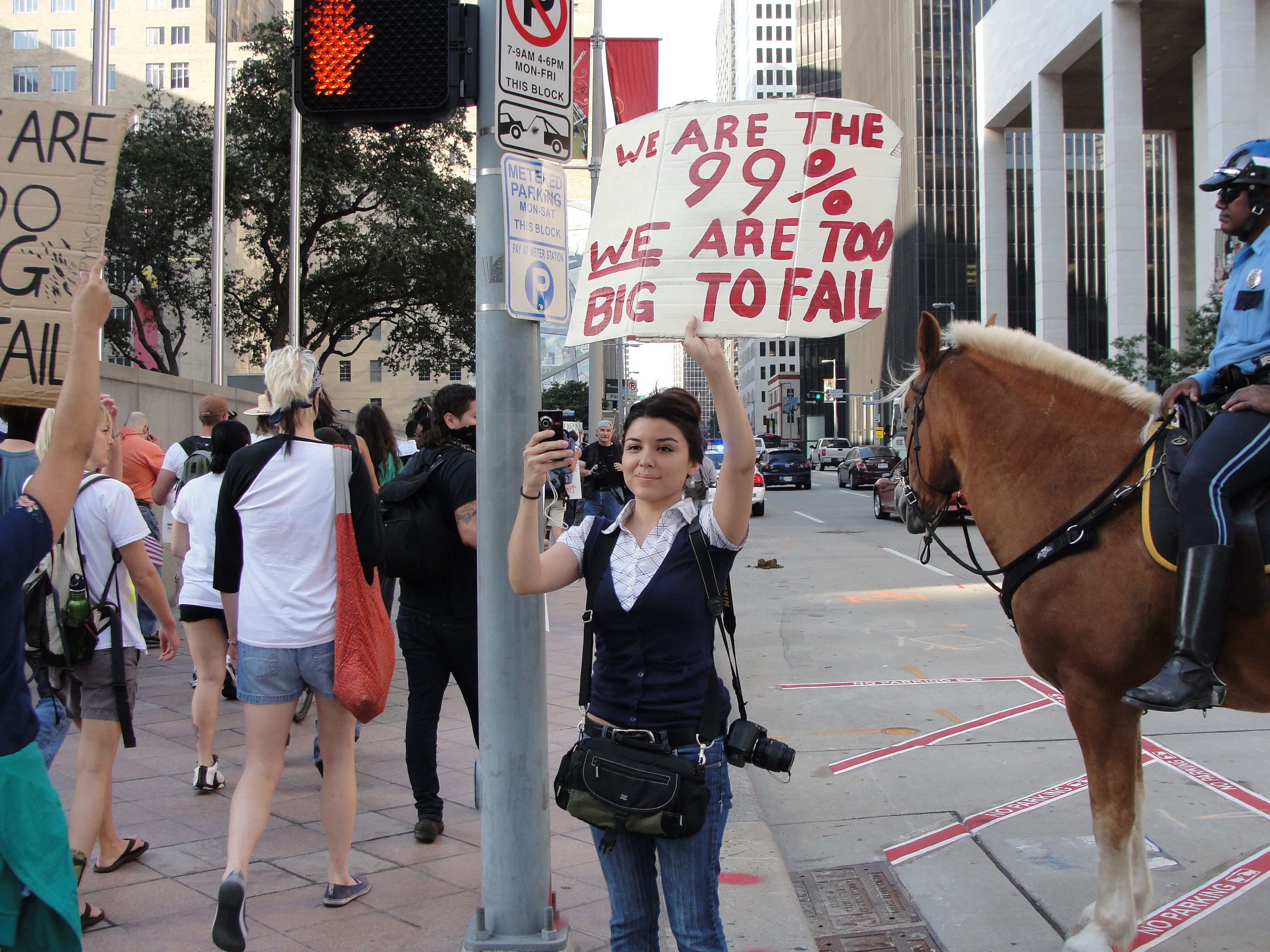
Which leads us to one of the main points of the Occupy protests: “We are the 99%!” What do they mean by this? By 99% they are referring to the majority of the people who have no say so over decisions which affect our country as opposed to the 1% who control the vast majority of the wealth produced by working people. As long as we have vast resources under the control of the ultra-wealthy, we will have wars, and bail outs. Education, health care and all public services will be cut. Jobs will be cut to increase profits and homes will be seized and many people will be left penniless and on the street.

So what are the demands of the workers now? It is fairly clear to those who understand the condition of the working class. It is unfathomable to the wealthy owners of the corporations.

Working people are demanding an end to the greatest disparity in income ever seen in the history of this country. Working people are demanding jobs with benefits so that they can sustain their families. Working people are demanding dignity and respect on the job. Working people are demanding an end to the endless imperialistic wars in the middle East and Africa.

Working people are demanding the right to organize and collectively bargain. Working people around the world are fed up with austerity and cuts to programs which benefit the working class and their children. The working class is demanding on an international scale their fair share of the wealth they have created.

These demands are simple and direct and would result in an improvement in working conditions for U.S. workers.

Continuing to ignore these demands will only result in further alienation of the working class and none of us know where that might lead. It could lead to socialism and worker’s democracy. Wake up, Wall Street, the specter of a real working class movement is haunting the world!

Occupy Houston gets underway
| October 6, 2011 | 9:27 pm | Action | Comments closed

By James Thompson

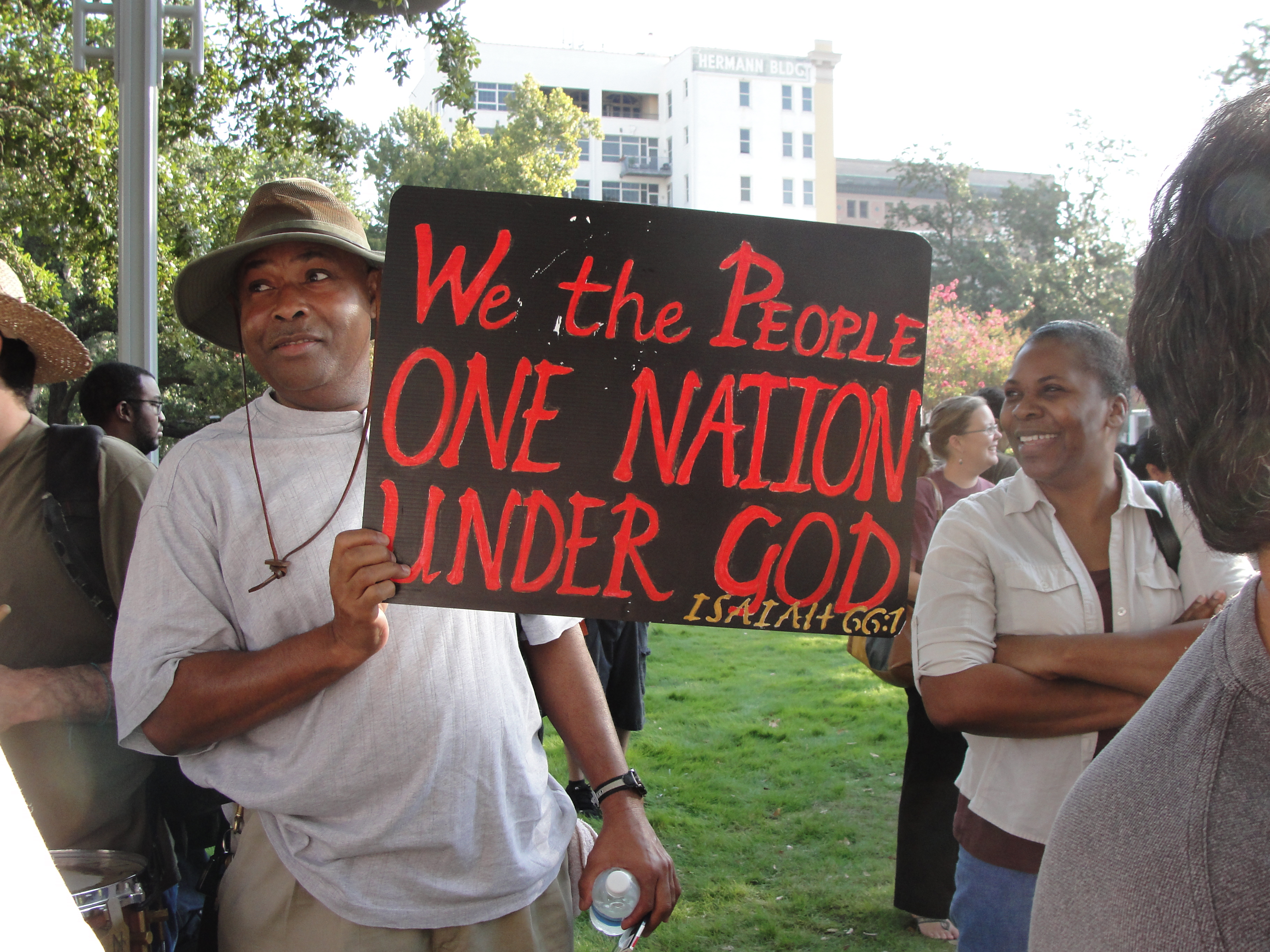
HOUSTON – About 600 activists helped launch the Occupy Houston event today (10/6/11)to express solidarity with the Occupy Wall Street effort. The crowd was peaceful and there were no confrontations with police. The closest thing that I witnessed to a confrontation was when a mounted police officer yelled at several of us “Stop!” in a tone of voice that commanded our attention. When I regained my composure, I realized that the people in front of me had almost walked out into ongoing traffic and the officer probably saved their lives. After it was over, I heard him say, “I just didn’t want anyone to get hurt.” This is quite a contrast to the treatment of the protesters in New York City by NYPD.

The crowd was diverse and consisted of men and women, Anglos, African Americans, Latinos, Asians who were young and old and represented a wide variety of progressive organizations. Organizations represented included Houston United, CRECEN, HIWJC, Harris County AFL-CIO, UAW, IBEW, AFT, Houston Peace and Justice Center, KPFT, Houston Peace Council, Houston Communist Party, Harris County Green Party and many others.

I didn’t see any Tea Party counter protesters, but the Houston Chronicle found one and devoted numerous pictures to his antics.

The event commenced at 8:30am at Market Square Park and we marched to the JP Morgan Chase Bank Tower, where a brief rally took place, and then proceeded to Hermann Square Park in front of Houston City Hall. The occupation then started at Hermann Square Park.

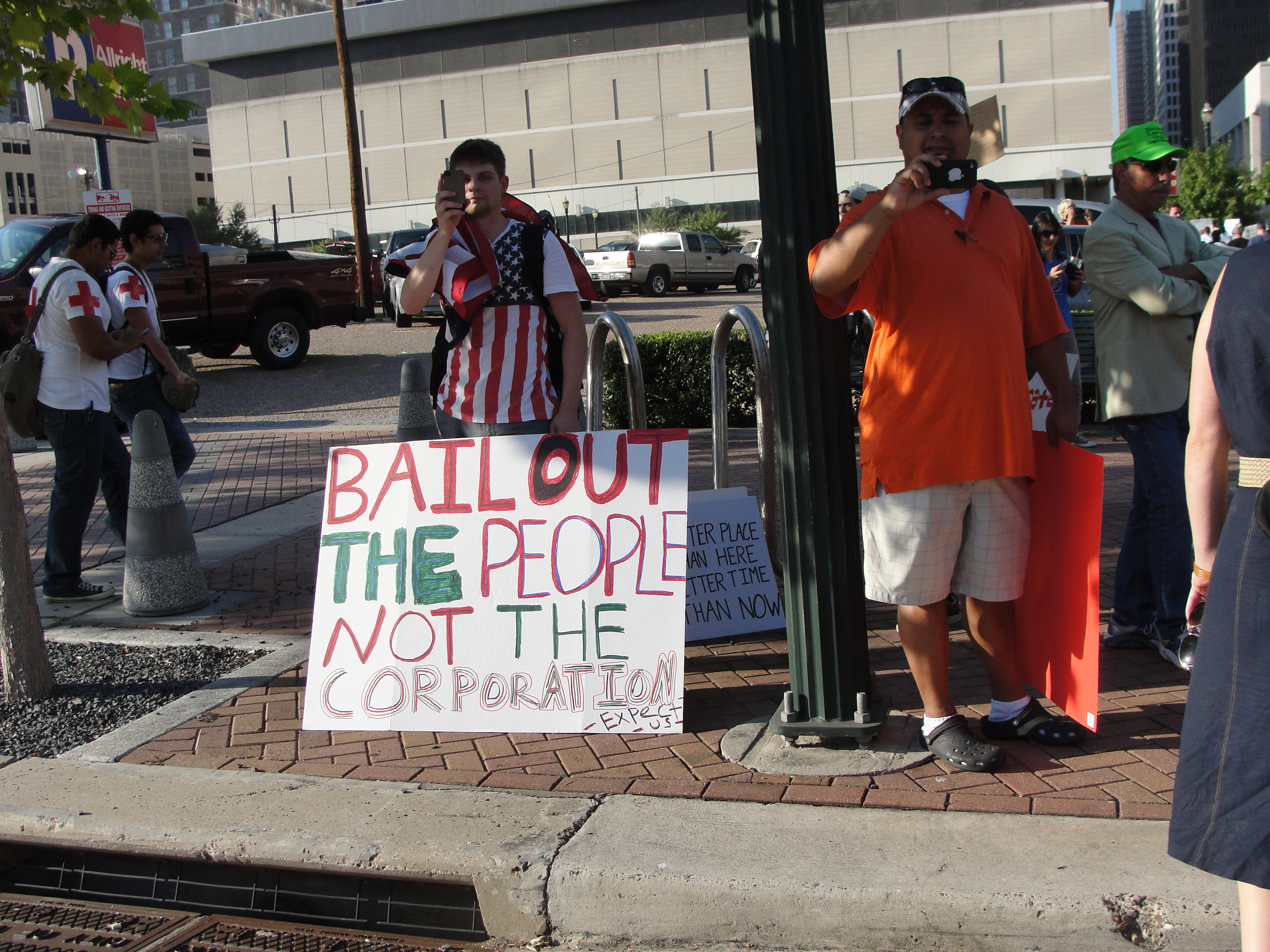
Iraq veterans were present and one addressed the crowd, proclaiming that he loves America and fought for America, but vigorously protested high unemployment rates, corporate bailouts and corporate greed.

The Houston Chronicle quoted one participant in this demonstration of democracy, “‘I think that money plays too big a role in our political process in this moment in history, and I believe it’s damaging the country,’ said Eugene Hayman, 57, a chemical plant worker from Deer Park. ‘I’m afraid what the future holds if the people with all the money continue to run this country in a way that profits them at the expense of everyone else.’”

The crowd was loud and spirited. We chanted, “They (banks) got bailed out, we got sold out!” “The people united will never be defeated!” and “Hey, hey, ho, ho, corporate greed has got to go!” People also shouted “We are…the 99%!” referring to the fact that the top 1% control the wealth and the rest of us work for them.

Many people voiced frustration with the lack of a comprehensive health care system and that the current system serves the wealthy and is paid for by the poor.

Many people were also present to support immigrant worker rights.

Demonstrations across the country were taking place today as well including Washington, D.C., Austin, Dallas, San Antonio and many others.

President Barack Obama had this to say “I think people are frustrated and the protesters are giving voice to a more broad-based frustration about how our financial system works…The American people understand that not everybody has been following the rules, that Wall Street is an example of that…and that’s going to express itself politically in 2012 and beyond.”

Mr. President, this is only the beginning! The American people are fully awake and recognize that the countless wars in which the U.S. is embroiled are leeching away our vital national resources to serve the interests of the wealthy and their corporations. The 99% are demanding their fair share of the wealth that they have produced. Although the 1% are ruthless, brutal and employ the most terroristic tactics to control the working people, they are hopelessly outnumbered by those they have exploited and oppressed. From what I saw today, working people are ready to fight for their interests.

Class Warfare Indeed
| October 4, 2011 | 9:54 pm | Action | Comments closed

By Michael Parenti, Reader Supporter News

via http://readersupportednews.org/opinion2/279-82/7691-class-warfare-indeed

03 October 11

Over the last two decades or more, Republicans have been denouncing as “class warfare” any attempt at criticizing and restraining their mean one-sided system of capitalist financial expropriation.

The moneyed class in this country has been doing class warfare on our heads and on those who came before us for more than two centuries. But when we point that out, when we use terms like class warfare, class conflict, and class struggle to describe the system of exploitation we live under – our indictments are dismissed out of hand and denounced as Marxist ideological ranting, foul and divisive.

Amanda Gilson put it perfectly in a posting on my Facebook page: “[T]he concept of ‘class warfare’ has been hi-jacked by the wrong class (the ruling class). The wealthy have been waging war silently and inconspicuously against the middle and the poor classes for decades! Now that the middle and poor classes have begun to fight back, it is like the rich want to try to call foul—the game was fine when they were the only ones playing it.”

The reactionary rich always denied that they themselves were involved in class warfare. Indeed, they insisted no such thing existed in our harmonious prosperous society. Those of us who kept talking about the realities of class inequality and class exploitation were readily denounced. Such concepts were not tolerated and were readily dismissed as ideologically inspired.

In fact, class itself is something of a verboten word. In the mainstream media, in political life, and in academia, the use of the term “class” has long been frowned upon. You make your listeners uneasy (“Is the speaker a Marxist?”). If you talk about class exploitation and class inequity, you will likely not get far in your journalism career or in political life or in academia (especially in fields like political science and economics).

So instead of working class, we hear of “working families” or “blue collar” and “white collar employees”. Instead of lower class we hear of “inner city poor” and “low-income elderly.” Instead of the capitalist owning class, we hear of the “more affluent” or the “upper quintile.” Don’t take my word for it, just listen to any Obama speech. (Often Obama settles for an even more cozy and muted term: “folks,” as in “Folks are strugglin’ along.”)

“Class” is used with impunity and approval only when it has that magic neutralizing adjective “middle” attached to it. The middle class is an acceptable mainstream concept because it usually does not sharpen our sense of class struggle; it dilutes and muffles critical consciousness. If everyone in America is middle class (except for a few superrich and a minor stratum of very poor), there is little room for any awareness of class conflict.

That may be changing with the Great Recession and the sharp decline of the middle class (and decline of the more solvent elements of the working class). The concept of middle class no longer serves as a neutralizer when it itself becomes an undeniable victim.

“Class” is also allowed to be used with limited application when it is part of the holy trinity of race, gender, and class. Used in that way, it is reduced to a demographic trait related to life style, education level, and income level. In forty years of what was called “identity politics” and “culture wars,” class as a concept was reduced to something of secondary importance. All sorts of “leftists” told us how we needed to think anew, how we had to realize that class was not as important as race or gender or culture.

I was one of those who thought these various concepts should not be treated as being mutually exclusive of each other. In fact, they are interactive. Thus racism and sexism have always proved functional for class oppression. Furthermore, I pointed out (and continue to point out), that in the social sciences and among those who see class as just another component of “identity politics,” the concept of class is treated as nothing more than a set of demographic traits. But there is another definition of class that has been overlooked.

Class should also be seen as a social relationship relating to wealth and social power, involving a conflict of material interests between those who own and those who work for those who own. Without benefit of reason or research, this latter usage of class is often dismissed out of hand as “Marxist.” The narrow reductionist mainstream view of class keeps us from seeing the extent of economic inequality and the severity of class exploitation in society, allowing many researchers and political commentators to mistakenly assume that U.S. society has no deep class divisions or class conflicts of interest.
We should think of class not primarily as a demographic trait but as a relationship to the means of production, as a relationship to power and wealth. Class as in slaveholder and slave, lord and serf, capitalist and worker. Class as in class conflict and class warfare.

And who knows, once we learn to talk about the realities of class power, we are on our way to talking critically about capitalism, another verboten word in the public realm. And once we start a critical discourse about capitalism, we will be vastly better prepared to act against it and defend our own democratic and communal interests.
________________________________________
Michael Parenti’s recent books include: “God and His Demons” (Prometheus), “Contrary Notions: The Michael Parenti Reader” (City Lights); “Democracy for the Few” 9th ed. (Wadsworth); “The Assassination of Julius Caesar” (New Press), “Superpatriotism” (City Lights), and “The Culture Struggle” (Seven Stories Press). For further information, visit his website: www.michaelparenti.org.

Occupy Houston!
| October 3, 2011 | 8:49 pm | Action | Comments closed

Here is the website for the Occupy Houston effort scheduled for October 6.

http://occupyhouston.org/take-direct-action/

There is a better way
| October 1, 2011 | 9:37 pm | Action | Comments closed

What can we learn from Karl Marx regarding the swelling second wave of the global economic crisis with its epicenter in Europe?

Writing in the first volume of Capital nearly 150 years ago, Marx added to the end of the first chapter a curious essay entitled “The Fetishism of Commodities and the Secret Thereof.” Coming after a rigorous argument that places the commodity at the center of his analysis of capitalism, section 4 reads like a disclaimer of all that precedes it:

Man’s reflections on the forms of social life, and consequently, also, his scientific analysis of those forms, take a course directly opposite to that of their actual historical development. He begins, post festum, with the results of the process of development ready to hand before him. The characters that stamp products as commodities, and whose establishment is a necessary preliminary to the circulation of commodities, have already acquired the stability of natural, self-understood forms of social life, before man seeks to decipher, not their historical character, for in his eyes they are immutable, but their meaning. Consequently it was the analysis of the prices of commodities that alone led to the determination of the magnitude of value, and it was the common expression of all commodities in money that alone led to the establishment of their characters as values. It is, however, just this ultimate money form of the world of commodities that actually conceals, instead of disclosing, the social character of private labour, and the social relations between the individual producers. When I state that coats or boots stand in a relation to linen, because it is the universal incarnation of abstract human labour, the absurdity of the statement is self-evident.

Nevertheless, when the producers of coats and boots compare those articles with linen, or, what is the same thing, with gold or silver, as the universal equivalent, they express the relation between their own private labour and the collective labour of society in the same absurd form.

The categories of bourgeois economy consist of such like forms. They are forms of thought expressing with social validity the conditions and relations of a definite, historically determined mode of production, viz., the production of commodities. The whole mystery of commodities, all the magic and necromancy that surrounds the products of labour as long as they take the form of commodities, vanishes therefore, so soon as we come to other forms of production.

The “secret” in this section is not only the secret to understanding commodities, even capitalism, but indeed the key to appreciating the Marxian method.

Marxism stands apart from “bourgeois economy” precisely because, through a dedicated study of history and revealed historical patterns, the Marxian method grasps that commodities, like markets, banks, and even today’s credit default swaps, are evolved and evolving human artifacts best understood through the constitutive relations between human actors who consciously construct and employ these instruments. That is to say, these elements, like the social relations that stand behind them, are neither fixed nor eternal, but changing and changeable.

Contrary to the pretentious, puffed up Hegelianism of celebrated pundit Francis Fukiyama, capitalism as we know it is not the “end of history.” And contrary to the triumphalism of iconic political figures like Margaret Thatcher, “There is No Alternative” is a foolish, bombastic slogan.

Yet today’s political leaders and economic thinkers are captured by the “magic and necromancy” of markets, as Marx might put it. They firmly believe that the profound economic crisis currently destroying thousands of lives and chewing up the standards of life of millions more can only be resolved in the narrow straight jacket of bourgeois economics and its eternal theological “laws.” But unlike the laws of nature, bourgeois economic laws reflect social relations, relations of social classes established by power, dominance, and privilege that might well be overturned or modified by human agency. We cannot replace the second law of thermodynamics for a “better” law of physics, but we can replace the current “laws” exhibited by the financial market place with new social relations and, consequently, a new financial order.

As Marx notes, this point is obscured for those unable to envision “other forms of production,” for those dogmatically wedded to the “immutable” laws of bourgeois economics.

With the exception of those fighting austerity and the tyranny of the popes of economic dogma such as the Greek Communist Party and others not constrained by any irrational fetish, the global economy remains strangled by the fetishism of markets and the financial predators exploiting that fetishism.

What is needed urgently is a break with stagnant, self-defeating thinking that elevates the cancerous financial sector and its privileged status among our institutions.

Witness the tragic pandering of progressive, social democratic, and other left political parties to the fetishism of financial markets throughout the world. The never ending demands of the agents of finance – the International Monetary Fund, the European Central Bank, and the European Union functionaries, in the case of Europe – bleed working people of the little they have retained in the face of the economic hurricane unleashed in 2008. Relentlessly, a tiny elite of financial manipulators and their hedge funds, private equity firms and investment banks have extorted concessions in the form of vicious austerity programs imposed on the masses.

The more governments concede in jobs, spending, and public welfare, the worse their economies perform. The worse their economies perform, the greater their debt in relation to economic product. The greater the share of sovereign debt against national product, the greater the concessionary demands of the vultures of finance. And the cycle repeats endlessly. This is the kind of reductio ad absurdum that only a madman could embrace.

The laboratory for this insanity is Greece. For two years financial predators have swarmed the relatively small chunk of international debt held by the Greek government while demanding the surrender of Greek assets and social spending to cover or guarantee those debt claims. The EU leadership could have easily placed this debt in a secure strong box as they did for banks in 2008 and 2009, protecting Greece from the vultures. Instead, they did nothing but collaborate with the assault of the financial sector. That collaboration, along with the compliance of the politically bankrupt PASOK government, brought catastrophe to the Greek people.

Recent exposés of misery in The New York Times and The Wall Street Journal have only scratched the surface of the pain now being endured daily by the workers in Greece.

And the misery will continue with the passage of the latest package of property taxes, salary reductions and layoffs. As these draconian measures, extorted by the titans of finance, further slow the Greek economy, officials will shrilly note that the Greeks are now even further from reducing their national debt and even more crippled by debt service. There will surely be further demands of privatization and austerity.

Unmoved by the fetishism of markets and the iron discipline imposed by its doctrinaire disciples, a growing segment of the Greek population has joined with Greek Communists and militant trade union leaders to simply say “No!” to this voluntary enslavement. For them, there is no fear of crumbling capitalist institutions. There is no civil debate over the fate of extortionate European banks. There is no awe of a future without the imposing structures constructed by European elites to shape Europe to benefit the privileged.

Rather, they face the future with optimism. Instead of “There is No Alternative,” they offer “There must be a Better Way.” The rest of the world would wisely heed this message and take a hard look at the socialist option.

The old Moor, as his friends fondly called Karl Marx, would smile at the slogan: “We will not pay for your crisis!”

Zoltan Zigedy
zoltanzigedy@gmail.com


Posted By zoltan zigedy to ZZ’s blog at 10/01/2011 01:39:00 PM

Dallas Resident Serves on International Human Rights Observer Team in Honduras. Returns with Troubling Report
| September 29, 2011 | 7:45 pm | Action | Comments closed

September 27, 2011
Via http://www.houstonpeacecouncil.com/dallas-resident-serves-on-international-human-rights-observer-team-in-honduras-returns-with-troubling-report/

Tegucigalpa, Honduras- Local resident Ernest McMillan was one of nine U.S human rights observers returning to the United States this week after an intensive twelve-day investigation of the country’s worsening human rights crisis. Team members had been closely following events in Honduras since the June 28, 2009 coup d’Etat that ousted democratically elected President Mel Zelaya at gunpoint. “In the last two years since the coup, despite the supposed election of current President Pepe Lobo, there has been as many as 200 political assassinations of members and leaders of the growing popular resistance front known as the FNRP- Frente Nacional de Resistencia Popular.

“I felt compelled to go; to gain an awareness of the lives experienced by ordinary Hondurans who are struggling for justice, and dignity. Powerful forces oppose them with intense and seemingly relentless cruelties while they simply want to live and to provide for their children.” says McMillan. Several human rights organizations that are part of the U.S Honduras Solidarity Network assembled this emergency observation team to travel directly to the Aguan basin of Honduras where recent killings of campesino leaders and police/military raids of campesino communities have left dozens dead and hundreds as internal refugees. “While we were in the Aguan Region, there were two police/military raids on the same community (Los Rigores- September 16, 19) in which 22 people were temporarily detained, tortured and threatened with death. A 16 yr old was drenched in gasoline by the police and threatened with being burned. All the detainees were released with no charges filed.” reports Vicki Cervantes of Chicago’s human rights group La Voz de los de Abajo.

The US State Department recently lobbied for the re-entry of Honduras into the Organization of American States as part of an agreement facilitated by Colombia President Santos and Venezuela President Hugo Chavez in May of this year known as the Cartagena Accord. The US State Department was quick to recognize the 2009 election of Pepe Lobo while most nations in South America and Europe still do not recognize the current government of Honduras because of the political climate during the 2009 elections and the continued concerns about human rights violations in Honduras. “I am particularly concerned that the US government is perpetuating gross human rights abuses by providing military funds and training to the Honduras security forces. An example of this is the $40 million recently given by the State Department. “responds Dale Sorensen of the California based human rights group Task Force on the Americas. In May of this year 87 US congress members signed a scathing letter addressed to US Secretary Hillary Clinton regarding the continued human rights violations in Honduras asking the state department and US Embassy in Honduras to speak out against violence targeted towards human rights defenders and journalists. “When we asked the new US Ambassador Lisa Kubiske if the embassy had complied with any of the asks of congress, she replied the letter pre-dates her and ‘there is a time to speak out and a time not to’.” quotes Brian Stefan Szittai of the Cleveland based organization Inter-Religious Task Force on Central America.

The Observer Team’s preliminary findings show that the Honduras government is not completing its part of the Cartagena Accord, which includes: 1. Free return of all exiles to Honduras with out fear of prosecution. Four are already exiled again and one is under house arrest. 2. Investigations and prosecutions for political assassinations. There continues to be a 90% impunity rate and increase in politically motivated killings. 3. The allowance for the registration of the FNRP has a political force including the creation of a new political party. In the weeks leading up to the ratification of the FNRP’s new party, the FARP, there were 3 political assassinations of leaders of the FNPR leaving an unsafe environment for the political process to freely move forward. 4. Beginning the process for a new constituent assembly to re-write the constitution. This process has not been able to proceed and many claim was the trigger for the military coup that took place June 28, 2009. “It is clear the current Honduran government has not complied to the Cartagena Accord nor made a concerted effort to complete its commitment. Even more concerning is that there are reports of threats recently made by Honduran police against international human rights groups working in the Aguan Valley.” reports observer team organizer Tanya Cole of the human rights organization Witness for Peace Southwest.

Preliminary recommendations from the September Observer Team’s findings are 1. International Human Rights Organizations increase their attention on Honduras as the electoral process is pursued by the FARP and the land struggle continues in the Aguan Basin of Honduras. 2. That US congress and State Department take concrete and public action to condemn human right violations in Honduras and withhold military/police aid from Honduras while Honduran military and police agents continue to be complicit in forced disappearances, illegal raids, illegal detentions and human rights violations across the country.

CONTACTS:
Ernest McMillan
214.824.2433 (Home/Office)
emackdallas@gmail.com

Vicki Cervantes- Chicago
Phone: (312) 259-5042 (english/spanish)
Email: vickicervantes@yahoo.com

Tanya Cole- Los Angeles
phone: 805-421-9708 (eng/span)
Email: wfpsw@witnessforpeace.org

Houston organized labor fights back
| September 28, 2011 | 10:40 pm | Action | Comments closed

By James Thompson

Via http://www.houstonpeacecouncil.com/houston-organized-labor-fights-back/

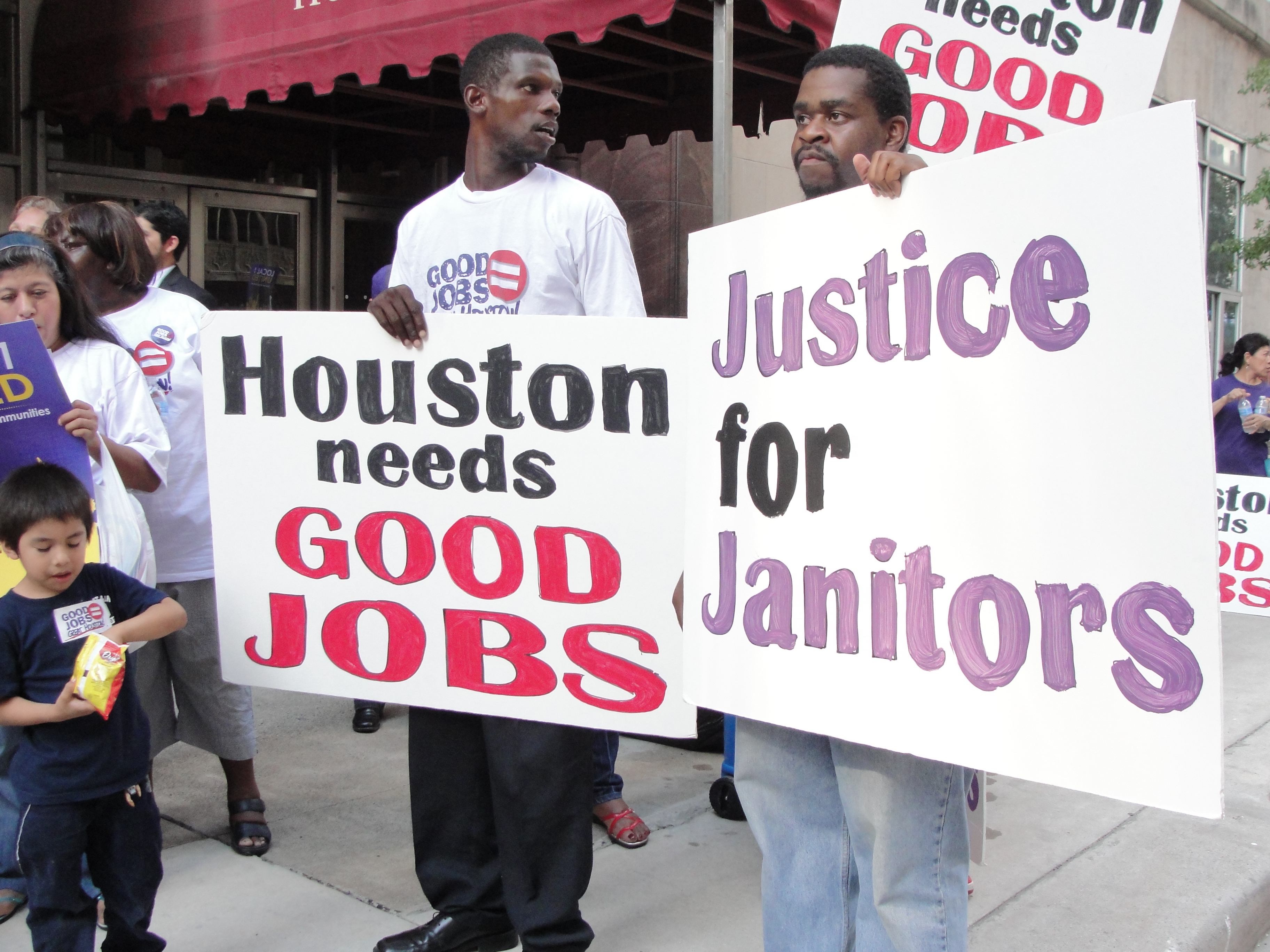
Houston Justice for Janitors Rally 9/28/11

HOUSTON – Although there have been relatively few organized labor rallies in Houston since the election of President Obama as compared with the administration of George W. Bush, this week may mark a change in direction.

As part of the national effort on Tuesday, September 27, 2011 to support the continuation of the postal service, there were numerous actions at various federal offices and Congressional offices around the city. I went to a rally held at the office of U.S. Congressperson John Culberson located just east of Chimney Rock at 10000 Memorial. The afternoon heat was stifling and probably kept many people away. Many postal workers and their supporters from the community were quite visible in front of the prestigious office building making a strong case to preserve the Postal Service and protect the jobs of some 600,000 postal workers. The rally was peaceful, non-violent, but spirited.

There were some police officers present from the Houston Police Department. One of them talked to one of the participants in the rally to find out what it was all about. When he found out the purpose of the rally, he related to us that there were efforts to cut his pension as well. He also told us that former President George Herbert Walker Bush had his office in the same building. He apparently looked out his window and spotted the demonstrators and promptly called HPD. HPD was very professional in their conduct and did not harass the participants in any way.

Today (September 28, 2011), in the sweltering Houston heat, I participated in a rally held in downtown Houston in front of the Houston Club located at 811 Rusk called by SEIU as part of the national Justice for Janitors day. The crowd of about 500 union members and their supporters from the community was also peaceful, non-violent but nevertheless spirited in their demands for a living wage and a fair contract for workers. Representatives from various organizations including the Houston Peace and Justice Center, SEIU, AFL-CIO, Houston Peace Council, Labor Council for Latin American Advancement and the Catholic Church were among the rally participants. Notably, City Councilperson Jolanda Jones was present to support the workers and addressed them in Spanish. She has been a vocal and visible proponent of the Justice for Janitors effort for many years.

It has become increasingly obvious to many people that the class war did not pause or halt during the Obama administration. In fact, some might suggest that it has sped up and intensified. The rise of the ultra right wing in the U.S. Congress has effectively thwarted any progressive movement from either the White House or progressive elements in the legislature.

National days of action are a step in the right direction, but mass movements to support the employed as well as the unemployed are needed to make the point that working people will not settle for injustice at the workplace and in the community anymore. What is also needed but not addressed in the rallies is more education for working people to help them understand the fact that the numerous wars of occupation around the world and the subsidization of the wealthy through tax breaks and bail outs are draining our national resources and revenues. This is why public service workers are under assault. If the right wing are unopposed, it could result in the destruction of our vital infrastructure to include such things as the postal service, roads, education, health care, law enforcement and ultimately even the military personnel. The wealthy classes have launched an all out class war against working people and they will do anything necessary to increase their profits. Working people, on the other hand, are the vast majority of people in this country and do not have to take this lying down. It is time to fight back and mean it.